...FROST ADVISORY REMAINS IN EFFECT UNTIL 8 AM CDT THIS MORNING... * WHAT...Temperatures near freezing and widespread frost. * WHERE...Calumet, Manitowoc, Winnebago, Brown, Door, Kewaunee and Outagamie Counties. * WHEN...Until 8 AM CDT this morning. * IMPACTS...Frost and freeze conditions could kill crops and other

Original Article

Current Watches, Warnings and Advisories for Brown (WIC009) Wisconsin Issued by the National Weather Service

Current Watches, Warnings and Advisories for Brown (WIC009) Wisconsin Issued by the National Weather Service

https://alerts.weather.gov/cap/wwacapget.php?x=WI1261A055BB80.FrostAdvisory.1261A0562D90WI.GRBNPWGRB.504f2eca69c1d4c92481f403bd348177


w-nws.webmaster@noaa.gov

...FROST ADVISORY REMAINS IN EFFECT UNTIL 8 AM CDT TUESDAY... * WHAT...Temperatures as low as 32 will result in frost formation. * WHERE...Calumet, Manitowoc, Winnebago, Brown, Door, Kewaunee and Outagamie Counties. * WHEN...Until 8 AM CDT Tuesday. * IMPACTS...Frost could harm sensitive outdoor vegetation. Sensitive

Original Article

Current Watches, Warnings and Advisories for Brown (WIC009) Wisconsin Issued by the National Weather Service

Current Watches, Warnings and Advisories for Brown (WIC009) Wisconsin Issued by the National Weather Service

https://alerts.weather.gov/cap/wwacapget.php?x=WI1261A0549430.FrostAdvisory.1261A0562D90WI.GRBNPWGRB.504f2eca69c1d4c92481f403bd348177
w-nws.webmaster@noaa.gov

...FROST ADVISORY IN EFFECT FROM MIDNIGHT TONIGHT TO 8 AM CDT TUESDAY... * WHAT...Temperatures near freezing and widespread frost. * WHERE...Calumet, Manitowoc, Winnebago, Brown, Door, Kewaunee and Outagamie Counties. * WHEN...From Midnight tonight to 8 AM CDT Tuesday.

Original Article

Current Watches, Warnings and Advisories for Brown (WIC009) Wisconsin Issued by the National Weather Service

Current Watches, Warnings and Advisories for Brown (WIC009) Wisconsin Issued by the National Weather Service

https://alerts.weather.gov/cap/wwacapget.php?x=WI1261A047C3B8.FrostAdvisory.1261A0562D90WI.GRBNPWGRB.504f2eca69c1d4c92481f403bd348177

w-nws.webmaster@noaa.gov

In Wisconsin, experimental projects underway in both Fond du Lac and Outagamie counties are pioneering the continuous use of conservation practices aimed at protecting the soil. The initiative incorporates no-till farming methods, planting of cover crops and the use of low-disturbance manure injection instead of spraying manure onto bare, open fields. Read the full story by the FDL Reporter.

Original Article

Great Lakes Commission

Great Lakes Commission

https://www.glc.org/dailynews/20210510-fdl

Beth Wanamaker

Algae blooms can be dangerous, but there is no system that captures the total picture of algal blooms in Wisconsin’s 15,000 lakes, according to a new study. Read the full story by the Journal Sentinel.

Original Article

Great Lakes Commission

Great Lakes Commission

https://www.glc.org/dailynews/20210510-blooms

Beth Wanamaker

So, should erosion control or lake access be the primary goal of a lakefront district, or can they build off each other? Is this lakefront district a wise long-term model, setting the stage for more public-private partnerships to create lake access or near-lake access for public trails? Or should allowing public lakefront access be required for those participating in any publicly subsidized program, which likely would reduce participation and could end the lakefront district before it starts? The Editorial Board Roundtable surveys the landscape. Read the full story by the Plain Dealer.

Original Article

Great Lakes Commission

Great Lakes Commission

https://www.glc.org/dailynews/20210510-erosion

Beth Wanamaker

With the recent confirmation of Deb Haaland to lead the Department of the Interior, the nation has its first Native American cabinet member. The position has significant influence on Native American affairs, and tribal representatives in Michigan say they’re optimistic about what Biden administration’s policies and Haaland’s position mean for Native representation. Read the full story by Capital News Service.

Original Article

Great Lakes Commission

Great Lakes Commission

https://www.glc.org/dailynews/20210507-haaland

Beth Wanamaker

Over the past 30 years, thousands of volunteers from around Northeast Ohio have picked up nearly 715 tons of trash along the Cuyahoga River. Saturday morning at the annual RiverSweep cleanup, hundreds more lent a hand to help keep the waterfront free of debris and trash. Read the full story by WEWS-TV – Cleveland, OH.

Original Article

Great Lakes Commission

Great Lakes Commission

https://www.glc.org/dailynews/20210507-riversweep

Beth Wanamaker

Preston Cole, Wisconsin Dept. of Natural Resources Secretary, spoke at the Water@UW-Madison Symposium. Image credit: Matthew Ginder-Vogel.

The fifth annual Water@UW-Madison spring symposium took place on Friday, May 7. This opportunity to connect water scholars and policymakers capitalized on opportunities in four areas: Wisconsin and climate change; per- and polyfluoroalkyl substances (PFAS); arts, culture and water; and the intersection of COVID and water.

Sea Grant’s Associate Director Jennifer Hauxwell is the current chair of the Water@UW-Madison executive committee. She put in a massive amount of planning and coordination to pull off the event that saw nearly 450 registrants and featured 40 speakers.

I’m also a member of the Water@UW-Madison executive committee but I only played a small role in the day, acting as the Twitter jockey. You can review the entire thread of the morning’s livestream. For a recap, here are a few Tweets that represented new information to me:

The WICCI (Wisconsin Initiative on Climate Change Impacts) #infrastructure working group is taking aim at the amount of #carbon in construction material. If concrete was a country, it would be the world’s third highest #carbon emitter after China and the U.S.

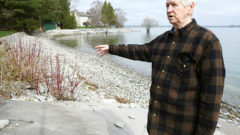
WICCI coastal resilience group helps ports, harbors and private property vulnerable to #GreatLakes water — at a record low in 2013 and now 6.5 feet higher. Working to build resilience to #changingcoasts #erosion #flooding

@julbusk Describes the Flow Project, which connects artists and Wisconsin researchers. Check out their lovely work.

All of us listening to the symposium have some #PFAS in us @remucal

Whole lot of graphing going on here. Greg Harrington says water use during the pandemic drops at the commercial level and increases in homes to 60% and those folks pay more for their water than commercial customers @UWMadisonCEE


Finally, things were moving quickly, so I never did get a chance to tweet some meaningful quotes of the morning. I actually had them teed up, and this is how they would have been shared, if I had pushed them into the stream:
Water defines life in Wisconsin, @saackerman, UW-Madison vice chancellor for research and graduation education.

We need to protect our nature-based and water economy, Sec. Preston Cole @WDNR.

Water issues are people issues, Jennifer Hauxwell, chair of the Water@UW-Madison executive committee.

Water@UW-Madison is an umbrella organization that amplifies the water expertise of 130 faculty and staff across more than 40 departments and programs. Its scholarship represents topics such as water quality, invasive species and water policy. Anyone can join.


The post Revisit water symposium through Tweets first appeared on Wisconsin Sea Grant.

Original Article

Blog – Wisconsin Sea Grant

Blog – Wisconsin Sea Grant

https://www.seagrant.wisc.edu/blog/revisit-water-symposium-through-tweets/

Moira Harrington

As Line 5 debate continues, residents weigh risks to shorelines, economies

By Julie Riddle, The Alpena News

This article is part of a collaboration between The Alpena News and Great Lakes Now at Detroit Public Television to bring audiences stories about the Great Lakes, especially Lake Huron and its watershed.

ALPENA — In six days, oil escaping from under the Straits of Mackinac could reach Rogers City.

Read Now at Great Lakes Now.

Original Article

Great Lakes Now

Great Lakes Now

https://www.greatlakesnow.org/2021/05/line-5-debate-residents-risks-shorelines-economies/

The Alpena News

News Up North: Great Lakes Now teams up with Alpena publication for more news about Lake Huron

With regular coverage of marine sanctuary research, Lake Huron’s fishing and other recreational activity and watchdog journalism, The Alpena News daily newspaper brings readers the latest about a four-county Great Lakes community.

Through a new partnership with Great Lakes Now, those stories will reach a larger audience as they will be regularly published on the GreatLakesNow.org website.

Read Now at Great Lakes Now.

Original Article

Great Lakes Now

Great Lakes Now

https://www.greatlakesnow.org/2021/05/alpena-publication-lake-huron-partnership/

GLN Editor

Several thousand miles of hiking, multi-use, equestrian, motorized, fishing access and mountain biking trails across Ohio are mapped in a new app from the Ohio Department of Natural Resources. 

The post Ohioans DETOUR on recreational trails with free app first appeared on Great Lakes Echo.

Original Article

Great Lakes Echo

Great Lakes Echo

http://greatlakesecho.org/2021/05/10/ohioans-detour-on-recreational-trails-with-free-app/

Guest Contributor

...FROST ADVISORY REMAINS IN EFFECT UNTIL 8 AM CDT MONDAY... * WHAT...Temperatures of 32 to 36 will result in frost formation. * WHERE...Portions of central, east central, and northeast Wisconsin. * WHEN...Until 8 AM CDT Monday. * IMPACTS...Frost could harm sensitive outdoor vegetation. Sensitive outdoor plants may be killed if left uncovered.

Original Article

Current Watches, Warnings and Advisories for Brown (WIC009) Wisconsin Issued by the National Weather Service

Current Watches, Warnings and Advisories for Brown (WIC009) Wisconsin Issued by the National Weather Service

https://alerts.weather.gov/cap/wwacapget.php?x=WI1261A0456C80.FrostAdvisory.1261A046EB50WI.GRBNPWGRB.9a8cdadfe467da9e002f68f10e50cd4e

w-nws.webmaster@noaa.gov

...FROST ADVISORY IN EFFECT FROM MIDNIGHT TONIGHT TO 8 AM CDT MONDAY... * WHAT...Cold temperatures near freezing and widespread frost. * WHERE...Portions of central, east central, and northeast Wisconsin. * WHEN...From Midnight tonight to 8 AM CDT Monday. * IMPACTS...Frost could harm sensitive outdoor vegetation. Sensitive

Original Article

Current Watches, Warnings and Advisories for Brown (WIC009) Wisconsin Issued by the National Weather Service

Current Watches, Warnings and Advisories for Brown (WIC009) Wisconsin Issued by the National Weather Service

https://alerts.weather.gov/cap/wwacapget.php?x=WI1261A038A374.FrostAdvisory.1261A046EB50WI.GRBNPWGRB.9a8cdadfe467da9e002f68f10e50cd4e

w-nws.webmaster@noaa.gov

...FREEZE WARNING REMAINS IN EFFECT UNTIL 8 AM CDT THIS MORNING... * WHAT...Sub-freezing temperatures and widespread frost. * WHERE...Winnebago, Calumet, Kewaunee, Manitowoc, Brown and Outagamie Counties. * WHEN...Until 8 AM CDT this morning. * IMPACTS...Frost and freeze conditions could severely injure or

Original Article

Current Watches, Warnings and Advisories for Brown (WIC009) Wisconsin Issued by the National Weather Service

Current Watches, Warnings and Advisories for Brown (WIC009) Wisconsin Issued by the National Weather Service

https://alerts.weather.gov/cap/wwacapget.php?x=WI1261A027AE70.FreezeWarning.1261A02866D0WI.GRBNPWGRB.efb3194e41191745c4b220d0f0ca36ac

w-nws.webmaster@noaa.gov

...FREEZE WARNING REMAINS IN EFFECT UNTIL 8 AM CDT SATURDAY... * WHAT...Sub-freezing temperatures as low as 30 are expected. * WHERE...Waushara, Calumet, Manitowoc, Winnebago, Brown, Door, Kewaunee, Outagamie, Southern Marinette County and Southern Oconto County Counties. * WHEN...Until 8 AM CDT Saturday.

Original Article

Current Watches, Warnings and Advisories for Brown (WIC009) Wisconsin Issued by the National Weather Service

Current Watches, Warnings and Advisories for Brown (WIC009) Wisconsin Issued by the National Weather Service

https://alerts.weather.gov/cap/wwacapget.php?x=WI1261A026CB18.FreezeWarning.1261A02866D0WI.GRBNPWGRB.3612753692ff69d3fd30c91b34cf79db

w-nws.webmaster@noaa.gov

...FREEZE WARNING IN EFFECT FROM MIDNIGHT TONIGHT TO 8 AM CDT SATURDAY... * WHAT...Sub-freezing temperatures as low as 30 expected. * WHERE...Door, Outagamie, Brown, Kewaunee, Waushara, Winnebago, Calumet, Manitowoc, Southern Marinette County and Southern Oconto County Counties.

Original Article

Current Watches, Warnings and Advisories for Brown (WIC009) Wisconsin Issued by the National Weather Service

Current Watches, Warnings and Advisories for Brown (WIC009) Wisconsin Issued by the National Weather Service

https://alerts.weather.gov/cap/wwacapget.php?x=WI1261A01A0FB8.FreezeWarning.1261A02866D0WI.GRBNPWGRB.3612753692ff69d3fd30c91b34cf79db

w-nws.webmaster@noaa.gov

This week: Dr. Rob Letscher — Board Spotlight + Groups Continue Fight to Protect a River from an Open Pit Mining Project + Bureaucracy Blamed for Poor Communication + Need Our Water Urges More Aggressive PFAS Cleanup + CPI International Generously Donates a Portion of Sales to Freshwater Future


Dr. Robert Letscher — Board Spotlight

Meet Dr. Robert Letscher, who has served as secretary of Freshwater Future’s Board since 2019. As a professional Earth scientist and assistant professor of chemical oceanography at the University of New Hampshire, Rob’s expertise and knowledge have been invaluable to our organization. Though living full-time on the East Coast, Rob feels fortunate to spend summers along the northern shores of Lake Michigan. Read more about Rob’s research interests and his work focused on protecting our water resources.


Groups Continue Fight to Protect a River from an Open Pit Mining Project

A proposed open pit metals mine, just 150 feet from the shore of the Menominee River, was dealt a blow with a recent verdict overturning a wetland permit. Several organizations in Wisconsin and Michigan, including SAVE the Menominee River, Menominee Indian Tribe, Menikanaehkem, and Mining Action Group, banned together to voice their concerns about the potential impacts to the wetlands and river that is the drinking water source for nearby cities. In addition, another recent court decision ruled that new evidence from the Menominee Indian Tribe of Wisconsin should be allowed to be submitted in regards to the mining permit.

Congratulations to the Coalition to SAVE the Menominee River and Mining Action Group for being  Frehwater Heroes.


Bureaucracy Blamed for Poor Communication

Michigan regulators waited eight months to inform residents about potential contamination of their drinking water with the “forever chemicals” called PFAS near the Traverse City airport. During this time the state had regular communications with airport officials. Unfortunately, other communities have experienced similar delays in learning of nearby contamination. It makes us wonder what would have happened in Pellston, Michigan if high school students hadn’t played a role in discovering the PFAS contamination in partnership with Freshwater Future–how long would the state have waited before testing residential wells? New leadership at the state agency overseeing PFAS has vowed to change and inform residents when pollution is found. This change is long overdue, and we hope is a first step for Michigan Agencies to remember their responsibility to protect Michigan residents and not just profits.


Need Our Water Urges More Aggressive PFAS Cleanup

In Oscoda, MI ‘Need Our Water’ advocacy group has composed a letter urging the Air Force to implement more aggressive PFAS cleanup protocols. The Air Force has been kicking the can down the road for years, neglecting the cleanup on PFAS and causing harm to many of the residents in the area. Now, over 200 sign-ons support this letter urging the cleanup that is long overdue.

Congratulations to Need Our Water (NOW) for being a Freshwater Hero. We are proud to recognize their efforts to address the PFAS contamination of drinking water and surface waters.


CPI International Generously Donates a Portion of Sales to Freshwater Future

During the month of May, CPI International, a leader in lab supply equipment and materials, will be donating a portion of sales directly to Freshwater Future and the Flint Community Lab to help ensure the healthy future of our waters in the Great Lakes region. The company is committed to making a social impact to ensure clean water. CPI International is a worldwide supplier of certified reference material, laboratory consumables, small equipment, and test kits to scientific professionals working in spectroscopy, chromatography, mass spectrometry, and microbiology. To learn more about CPI International, please visit www.cpiinternational.com.

Original Article

Blog – Freshwater Future

Blog – Freshwater Future

https://freshwaterfuture.org/freshwater-weekly/freshwater-weekly/

Freshwater Future

A lighthouse restoration project kicked off on Plum Island in northern Door County, Wisconsin. The front range light will receive new paint and foundation repairs, and the watch and lantern rooms of the 65-foot-tall rear range light will get a makeover. Read the full story by the Door County Pulse.

Original Article

Great Lakes Commission

Great Lakes Commission

https://www.glc.org/dailynews/20210507-plum

Laura Andrews

A 7-mile peninsula juts out into Lake Erie from the city of Erie, Pennsylvania, forming a magnificent natural harbor called Presque Isle Bay. Today, two active lighthouses protect the ships plying Lake Erie. The North Pierhead Lighthouse is one of them. Read the full story by the Erie Times-News.

Original Article

Great Lakes Commission

Great Lakes Commission

https://www.glc.org/dailynews/20210507-northpier

Laura Andrews

The U.S. Great Lakes St. Lawrence Seaway Development Corporation announced that eight U.S. ports in the Great Lakes-St. Lawrence Seaway System received the Robert J. Lewis Pacesetter Award registering increases in international cargo tonnage shipped through their ports during the 2020 navigation season. Read the full story by the Watertown Daily Times.

Original Article

Great Lakes Commission

Great Lakes Commission

https://www.glc.org/dailynews/20210507-port

Laura Andrews

Over the last few weeks, the Biden Administration and leaders in the U.S. House and Senate have put forward proposals to fix the nation’s inadequate drinking water and sewage treatment infrastructure through new federal investment.

New investment is sorely needed. The Great Lakes states of Illinois, Indiana, Michigan, Minnesota, New York, Ohio, Pennsylvania, and Wisconsin face more than $188 billion in water infrastructure repairs and upgrades over 20 years to meet clean water objectives and to protect the health of local communities, according to the U.S. EPA.

See how much money is needed to fix drinking water and wastewater infrastructure in each state in this chart.

Further, between 6 million and 10 million homes continue to receive their drinking water through lead service lines, posing a serious risk to their health. Last month, in a scathing assessment of the nation’s infrastructure, the American Society of Civil Engineers issued its national scorecard, granting a “C-” for drinking water infrastructure, “D” for stormwater infrastructure, and “D+” for wastewater infrastructure.

The state is dire. It is time to act. A top priority for the Healing Our Waters-Great Lakes Coalition is to boost federal investment in our nation’s water infrastructure.

We’ve looked at the House, Senate, and Biden Administration proposals to see how they stack up against one another. The U.S. Senate passed legislation last week, and over the next few months lawmakers will negotiate what a final package will look like. As is to be expected, the proposals differ in scope, ambition, and timeframe. The good news: All of the them boost federal investment to start to get at the immense backlog of work. The question is: How far is the nation willing to go to make water safer and more affordable?

Bigger Equals Better for People, Health, Communities

It’s important to not mince words: More funding will be better. More funding will mean that we will be able to tackle the problems more quickly. That means reducing sewage contamination that closes beaches. That means replacing lead service lines that threaten the health of people, especially children. That means reducing skyrocketing water bills that are pushing more and more people to the brink, unable to afford their water—one-in-three Americans, to be exact. There is no way around the fact that getting more money out the door more quickly will help accelerate addressing the country’s infrastructure crisis and thereby protect our health and our communities.

These Investments are Critical for the most Vulnerable Communities

The Environmental Protection Agency has found that pollution disproportionately impacts low-income, Indigenous, and communities of color. The water infrastructure crisis is no different, from lead contamination to sky-rocketing water utility bills. The country has the opportunity to right these wrongs. In this regard, the Biden and House plans offer both more funding as well as targeted programs to help vulnerable communities.

Comparing the House, Senate and Biden Plans

So how do the packages compare? When looking at the total financial investment in three major areas – drinking water infrastructure, wastewater treatment infrastructure, and lead-line replacement – the Biden Administration package comes out ahead.

  • Biden Administration Plan: $111 billion
  • House Plan: $101 billion
  • Senate Plan: $35 billion

(Note: Senate Republicans have put forward an infrastructure roadmap that proposes a $35 billion investment in drinking water and wastewater infrastructure over 5 years through “renewed federal policies and programs.” Due to the lack of details we cannot, at this time, provide a comparison of this proposal.)

The catch is that the Biden plan assumes funding over eight years, while the House and Senate plans are 5-year investments. If we look at annual investments, the House plan shows greater ambition:

  • House Plan: $20 billion/year
  • Biden Administration Plan: $13.875 billion/year
  • Senate Plan: $7 billion/year
  • Current appropriations: $3 billion/year

Each of these proposals provides a much-needed boost over current funding levels, although some are, obviously, larger in scope. Here are some quick-takeaways from each plan.

Senate plan is the most conservative plan, a first step focusing on nuts-and-bolts upgrades to water infrastructure. The Senate Environment and Public Works committee quickly picked up where they left off in the last Congressional session, introducing an expanded and bi-partisan comprehensive water infrastructure package, the Drinking Water and Wastewater Infrastructure Act. The bill, which passed the Senate last week, would invest more than $35 billion in water resource development projects of which more than 40 percent can be directly used to benefit small, disadvantaged, rural, and tribal communities through additional subsidization from the State Revolving Loan Funds or direct grant programs. Notably absent is any kind of targeted lead-line replacement program.

The Biden plan aims big—with a priority on lead-line replacement. The American Jobs Plan released earlier this month by the Biden Administration would invest $111 billion over 8-years in water infrastructure. Notably, the plan seeks to replace 100% of lead pipes and service lines nationwide, investing $45 billion through the EPA’s Drinking Water State Revolving Fund and the Water Infrastructure Improvements for the Nation Act grants. That’s the most funding dedicated to lead-line replacement in any of the three plans. And it’s needed. The plan also seeks to tackle new contaminants and supporting clean water infrastructure across rural communities, investing $10 billion to monitor and remediate toxic PFAS in drinking water and to invest in rural small water systems and household well and wastewater systems.

The House plan offers the biggest federal investment out of the gate. The House of Representatives has pieced together two major water infrastructure proposals focusing on drinking water and wastewater infrastructure investments, respectively. The Leading Infrastructure For Tomorrow’s (LIFT) America Act and Water Quality Protection and Job Creation Act of 2021 offer more than $78 billion in drinking water and wastewater water infrastructure investments – the most of any of the plans. The investment of $22.5 billion of lead-line replacement is half of the Biden Administration’s plan, but will still get $4.5 billion out per year for the first five years – far above the Senate’s $710 million.

The plan tackles toxic PFAS contamination (although lower than Biden plan) as well as offers $2.5 billion in wastewater infrastructure assistance to address the backlog of critical needs for Indian Tribes.

Coalition Urges Elected Officials to Go Big

The Healing Our Waters-Great Lakes Coalition is urging elected officials to be bold and to fund a water infrastructure plan that funds solutions to the immense challenge at hand. The decades-long disinvestment in water infrastructure by the federal government needs to be reversed. The Coalition and its allies are urging federal elected officials to invest at least $30 billion this fiscal year in the nation’s water infrastructure to protect the drinking water and health of local communities, as well as the health of iconic waters like the Great Lakes. These problems will not fix themselves. Quite the opposite: Delay will only make the problems worse and more expensive to solve. Too many cities and towns are living with unsafe water. And we need to do everything we can to ensure that every resident of this country has access to clean, safe, and affordable water. In the coming months, as the U.S. Congress and Biden Administration discuss how to address the nation’s water infrastructure crisis, we encourage elected officials to think big and act accordingly.

The post Biden, House, Senate Infrastructure Packages – Water Investments Explained appeared first on Healing Our Waters Coalition.

Original Article

Healing Our Waters Coalition

Healing Our Waters Coalition

https://healthylakes.org/biden-house-senate-infrastructure-packages-water-investments-explained/

Alexis Lopez-Cepero


During the month of May 2021, CPI International, a leader in lab supply equipment and materials, will be donating a portion of sales directly to Freshwater Future and the Flint Community Lab to help ensure the healthy future of our waters in the Great Lakes region. CPI International is committed to making a so.cial impact that promises clean water. CPI International is a worldwide supplier of certified reference material, laboratory consumables, small equipment, and test kits to scientific professionals working in spectroscopy, chromatography, mass spectrometry, and microbiology. To learn more about CPI International, visit their website www.cpinternational.com


Original Article

Blog – Freshwater Future

Blog – Freshwater Future

https://freshwaterfuture.org/marketing/public-relations/cpi-international-generously-donates-a-portion-of-sales-to-freshwater-future/

Freshwater Future

Native American tribes say the risk of an oil spill from the Line 5 oil pipeline poses a “grave threat” to their right to hunt, fish and gather in northern Michigan and the Great Lakes. Tribal nations in Michigan assert that the Straits of Mackinac remain critically important for tribal fishers in the region, connected with cultural and spiritual practices and as a way to pass down teachings through generations. Read the full story by Canada’s National Observer.

Original Article

Great Lakes Commission

Great Lakes Commission

https://www.glc.org/dailynews/20210506-tribes-line5

Ned Willig

A bipartisan bill to enhance wildlife protection was introduced in Congress this week. The Recovering America’s Wildlife Act would provide states, territories and tribes with $1.4 billion annually to protect important species and their associated habitats, and directs the money towards Wildlife Action Plans used by conservation agencies. Read the full story by Great Lakes Echo.

Original Article

Great Lakes Commission

Great Lakes Commission

https://www.glc.org/dailynews/20210506-conservation-bill

Ned Willig

Local elected officials and a Lake Erie environmental group raised the alarm Wednesday about a burst in new applications to expand or establish new intensive livestock operations on farms in the western Lake Erie watershed. Manure from these operations flows into tributaries and feed harmful algal bloom on Lake Erie. Read the full story by Toledo Blade.

Original Article

Great Lakes Commission

Great Lakes Commission

https://www.glc.org/dailynews/20210506-cafo-concerns

Ned Willig

Ohio Governor Mike DeWine stopped in Toledo, Ohio, on Wednesday, to highlight Lake Erie as a tourism destination on Ohio Tourism Day. Governor DeWine touted his H2Ohio initiative to address serious water issues in Ohio, including harmful algal blooms on Lake Erie caused by phosphorus runoff from farm fertilizer. Read the full story by TV – WTOL – Toledo, Ohio.

Original Article

Great Lakes Commission

Great Lakes Commission

https://www.glc.org/dailynews/20210506-dewine

Ned Willig

The Lake Express Ferry will launch its 2021 travel season on Friday, May 7 with four daily crossings on Lake Michigan between Milwaukee, Wisconsin, and Muskegon, Michigan. Officials say the four-engine powered ship provides the most daily crossings of Lake Michigan and the fastest service with each trip taking only two-and-a-half hours.  Read the full story by TV – WDJT – Milwauke, WI.

Original Article

Great Lakes Commission

Great Lakes Commission

https://www.glc.org/dailynews/20210506-milwaukee-ferry

Ned Willig

Heading into the summer season, water levels on Lake Erie are about 17 inches lower than they were last year, according to the Army Corps of Engineers. Lower levels will help lessen erosion and flooding issues along the lakeshore – especially near the western basin where the lake is much more shallow. Read the full story by TV – WOIO – Cleveland, Ohio.

Original Article

Great Lakes Commission

Great Lakes Commission

https://www.glc.org/dailynews/20210506-erosion

Ned Willig

Algae may vacuum microplastics, but also indicates greater health threat

This article was republished here with permission from Great Lakes Echo.

By Hannah Brock, Great Lakes Echo

A type of algae that a recent study found collects microfibers brings up questions about microplastic pollution impacts and how it could affect human health.

Read Now at Great Lakes Now.

Original Article

Great Lakes Now

Great Lakes Now

https://www.greatlakesnow.org/2021/05/algae-vacuum-microplastics-greater-health-threat/

Great Lakes Echo

Plastic debris is getting into the Great Lakes, our drinking water, and our food

Watershed cleanups are popular ways of dealing with local plastic pollution, but once large plastic trash disintegrates into microplastics, they're nearly impossible to pick up.

Read Now at Great Lakes Now.

Original Article

Great Lakes Now

Great Lakes Now

https://www.greatlakesnow.org/2021/05/plastic-debris-great-lakes-drinking-water-food/

Michigan Radio

Reinstatement of the Michigan Department of Natural Resources Wildlife Habitat Grant Program could provide significant funding for many habitat projects this year, the department said.

The post Michigan offers $1 million to improve wildlife habitat first appeared on Great Lakes Echo.

Original Article

Great Lakes Echo

Great Lakes Echo

http://greatlakesecho.org/2021/05/06/michigan-offers-1-million-to-improve-wildlife-habitat/

Guest Contributor

Recovering America’s Wildlife Act would provide states, territories and tribes with $1.4 billion annually to protect important species and their associated habitats.

The post Congress considers once-in-a-generation bill for conservation first appeared on Great Lakes Echo.

Original Article

Great Lakes Echo

Great Lakes Echo

http://greatlakesecho.org/2021/05/06/congress-considers-once-in-a-generation-bill-for-conservation/

Guest Contributor