News

Great Lakes Commission applauds EPA plan to accelerate Great Lakes restoration

Ann Arbor, Mich. – The Great Lakes Commission (GLC) today applauded a plan by the U.S. Environmental Protection Agency (U.S. EPA) to expand and accelerate activities to cleanup and restore Great Lakes Areas of Concern. The funding draws from the historic $1 billion investment in the Great Lakes Restoration Initiative included in the bipartisan Infrastructure Investment and Jobs Act. In addition to its enhanced focus on Areas of Concern, U.S. EPA reiterated its commitment to addressing other key issues such as harmful algal blooms, nutrient reduction, and aquatic invasive species, which are priorities for the GLC.

“Accelerating the restoration of Great Lakes Areas of Concern is a beneficial move for our region,” said GLC Chair Todd L. Ambs of Wisconsin. “This work protects the environment and human health and is a great economic driver for the region as well.” 

“The Great Lakes Commission is grateful to U.S. EPA for their continued partnership on efforts to restore Great Lakes resources,” said Erika Jensen, executive director of the GLC. “We forward to seeing this critical work continue in collaboration with other federal, state, and local partners.”

The Great Lakes Water Quality Agreement designated the Great Lakes Areas of Concern as significantly impaired locations in the Great Lakes basin. The plan released by U.S. EPA will lead to the restoration of 28 of the original 31 U.S. sites by 2030, with the remaining three set to be restored shortly thereafter.


The Great Lakes Commission, led by chair Todd L. Ambs, deputy secretary of the Wisconsin Department of Natural Resources (retired), is a binational government agency established in 1955 to protect the Great Lakes and the economies and ecosystems they support. Its membership includes leaders from the eight U.S. states and two Canadian provinces in the Great Lakes basin. The GLC recommends policies and practices to balance the use, development, and conservation of the water resources of the Great Lakes and brings the region together to work on issues that no single community, state, province, or nation can tackle alone. Learn more at www.glc.org.

Contact

For media inquiries, please contact Beth Wanamaker, beth@glc.org.

Recent GLC News

Upcoming GLC Events

View GLC Calendar

ARCHIVES

Original Article

Great Lakes Commission

Great Lakes Commission

https://www.glc.org/news/aocs-021722
Laura Andrews

Note to Editors: In the public interest and in accordance with FAA regulations, the USGS is announcing this low-level airborne project. Your assistance informing the local communities is appreciated.

Original Article

Region 3: Great Lakes

Region 3: Great Lakes

http://www.usgs.gov/news/state-news-release/media-alert-low-flying-helicopter-will-survey-southern-wisconsin-geologic

mlubeck@usgs.gov

PFAS News Roundup: Bill proposes blood testing for Indiana firefighters, potential PFA contamination in Pennsylvania deer

PFAS, short for per- and polyfluoroalkyl substances, are a group of widespread man-made chemicals that don’t break down in the environment or the human body and have been flagged as a major contaminant in sources of water across the country.

Keep up with PFAS-related developments in the Great Lakes area.

Read Now at Great Lakes Now.

Original Article

Great Lakes Now

Great Lakes Now

https://www.greatlakesnow.org/2022/02/pfas-news-roundup-annual-blood-tests-pennsylvania-deer/

Maya Sundaresan

Healing Our Waters-Great Lakes Coalition
Contact: Lindsey Bacigal, BacigalL@nwf.org, (734) 887-7113
Jordan Lubetkin, Lubetkin@nwf.org, (734) 904-1589

$1B Investment in Toxic Pollution Clean-up a ‘Game-Changer’ for Great Lakes, Communities

ANN ARBOR, MICH. (February 17, 2022)—The Biden Administration’s plan to invest an additional $1 billion to clean up toxic pollution in the Great Lakes region, announced today, will be essential to restore the Great Lakes and to protect the drinking water, public health, and jobs of millions of people in Illinois, Indiana, Michigan, Minnesota, Ohio, New York, and Wisconsin, according to the Healing Our Waters-Great Lakes Coalition.

“This investment will be a game-changer in the effort to clean up pollution that has poisoned local drinking water and threatened the health of communities,” said Laura Rubin, director of the Healing Our Waters-Great Lakes Coalition. “This investment will benefit millions of people, provide a shot in the arm to Great Lakes restoration efforts, and support local economies. We thank President Biden, his administration, and the members of Congress who supported this funding for recognizing the urgent need to address this serious threat.”

The Healing Our Waters-Great Lakes Coalition pushed for increased Great Lakes investments in the bipartisan Infrastructure Investment and Jobs Act. The bill contains an additional $1 billion for Great Lakes restoration actions.

The Environmental Protection Agency is directing that funding to clean up the most polluted sites in the region. These sites – called Areas of Concern – contain high levels of cancer-causing and health-threatening pollution, such as PCB’s, mercury, and other chemicals, that have poisoned the water and led to drinking water restrictions, fish consumption advisories, and beach closures.

“The clean-up of these toxic hot-spots will benefit communities most impacted by pollution, which tend to be low-income, Black, Latino, Asian and Indigenous communities,” said Brenda Coley, co-chair of the Coalition and co-executive director of Milwaukee Water Commons. “We thank EPA Administrator Michael Regan for his leadership in tackling the biggest pollution problems in the region and confronting environmental injustices that continue to plague our communities. As these projects move forward, it will be essential to engage and partner with local communities, as we strive to achieve the common goal of access to clean, safe and affordable drinking water.”

The U.S. and Canadian governments, in the 1980s, identified 43 contaminated sites, which they deemed Areas of Concern. To date, six sites have been remediated on the U.S. side. The Biden Administration anticipates Infrastructure Investment and Job Act funding will clean up 22 additional sites by 2030, including:

  • Illinois: Waukegan;
  • Indiana: Grand Calumet River;
  • Michigan: Clinton River, Detroit River, Manistique River, Muskegon Lake, River Raisin, Rouge River, St. Clair River, St. Marys River, and Torch Lake;
  • Minnesota/Wisconsin: St. Louis River;
  • Ohio: Black River, Cuyahoga River, and Maumee;
  • New York: Buffalo River, Eighteenmile, Rochester Embayment, and Niagara River;
  • Wisconsin: Fox River, Milwaukee Estuary, and Sheboygan.

“This funding will accelerate vital restoration efforts,” said Marnie Urso, co-chair of the Coalition and senior policy director for Audubon Great Lakes. “Many of these polluted sites are in communities along the Great Lakes shoreline that contain important habitat for birds. Federal investments to remediate these sites benefit people and wildlife —and these investments have been doing wonders to help recover declining populations of threatened and declining species such as the Piping Plover and Black Tern.  Thanks to this investment in the Great Lakes Restoration Initiative their future is brighter.”

The $1 billion in the bipartisan infrastructure bill was directed to support the Great Lakes Restoration Initiative, which has supported the restoration of fish and wildlife habitat, clean-up of toxic pollution, reduction of farm and city runoff, and management of invasive species. Increasingly, restoration investments have been heralded as a way to help communities prepare for and adapt to climate change.

“Investments to restore the habitat, wetlands and natural areas around these toxic hotspots will be vital to restore the Great Lakes and help communities deal with the impacts from a changing climate,” said Mike Shriberg, co-chair of the Coalition and regional executive director of the National Wildlife Federation’s Great Lakes Regional Center. “The region is already experiencing more erratic weather and increased rain due to climate change. These investments will help communities combat flooding, sewage overflows, and other problems that are being exacerbated by global warming.”

Federal Great Lakes Restoration Initiative investments over the last 12 years have helped clean up long-standing legacy pollutants. The infusion of an additional $1 billion will allow more sites to be remediated more quickly.

“This funding will help close the book on one of the most infamous pollution episodes in our nation’s history,” said Lynn McClure, co-chair of the Coalition and senior regional director of the National Parks Conservation Association. “The EPA’s goal is to use these funds to clean up and restore highly polluted areas, including the Cuyahoga River Area of Concern—the same river that caught fire and sparked a national environmental movement. Cleaning up this corridor, which extends for 100 miles through northern Ohio and Cuyahoga Valley National Park, will be good for the people and wildlife that visit and call this area home.”

The bipartisan infrastructure bill, passed by the Senate and the House in the fall, contains significant federal investments to update the nation’s water infrastructure and address other clean water priorities in the Great Lakes region and across the country. Read more about the EPA’s Area of Concern program.

Since 2004, the Healing Our Waters-Great Lakes Coalition has been harnessing the collective power of more than 170 groups representing millions of people, whose common goal is to restore and protect the Great Lakes. Learn more at HealthyLakes.org or follow us on Twitter @HealthyLakes.

###

The post $1B Investment in Toxic Pollution Clean-up a ‘Game-Changer’ for Great Lakes, Communities appeared first on Healing Our Waters Coalition.

Original Article

Healing Our Waters Coalition

Healing Our Waters Coalition

https://healthylakes.org/1b-investment-in-toxic-pollution-clean-up-a-game-changer-for-great-lakes-communities/

Lindsey Bacigal

Many people, including researchers, have regarded Detroit as a food desert. Yet the term food desert is no longer correct in describing all of Detroit. The U.S. Department of Agriculture considers a census tract to be a food desert based on its poverty rate and the proportion of residents living more than a mile from a supermarket or large grocery store.

The post Detroit’s status as ‘food desert’ challenged first appeared on Great Lakes Echo.

Original Article

Great Lakes Echo

Great Lakes Echo

http://greatlakesecho.org/2022/02/17/detroits-status-as-food-desert-challenged/

Guest Contributor

River advocates and environmental regulators intend to fan out across northern Lower Michigan in coming months and determine where blooms of invasive “rock snot” algae threaten otherwise pristine, freshwater streams. Read the full story by MLive.

Original Article

Great Lakes Commission

Great Lakes Commission

https://www.glc.org/dailynews/20220216-rock-snot

Samantha Tank

The Climate Adaptation Science Center, a partnership between the University of Minnesota and the U.S. Department of Interior, will study climate change and the intersection of human activity and wildlife management in the Upper Midwest and Great Lakes region. It will pay special attention to tribal concerns and build off the unique and robust experience of Midwest Indigenous communities. Read the full story by WTIP – Cook County, MN.

Original Article

Great Lakes Commission

Great Lakes Commission

https://www.glc.org/dailynews/20220216-climate-center

Samantha Tank

A study by the University of Wisconsin-Madison found tributary rivers that feed into Lake Michigan play a critical role in transporting cancer-linked “forever chemicals” perfluoroalkyl acids, or PFAAs, into the Great Lakes system. Read the full story by The Hill.

Original Article

Great Lakes Commission

Great Lakes Commission

https://www.glc.org/dailynews/20220216-forever-chemicals

Samantha Tank

New report finds Enbridge Line 5 closure will cause little pain to Michigan

By Zahra Ahmad, Bridge Michigan

The Great Lakes News Collaborative includes Bridge Michigan; Circle of Blue; Great Lakes Now at Detroit Public Television; and Michigan Radio, Michigan’s NPR News Leader; who work together to bring audiences news and information about the impact of climate change, pollution, and aging infrastructure on the Great Lakes and drinking water.

Read Now at Great Lakes Now.

Original Article

Great Lakes Now

Great Lakes Now

https://www.greatlakesnow.org/2022/02/new-report-enbridge-line-5-closure-michigan/

Bridge Michigan

The owner of a Northwest Indiana steel mill will pay $3 million in penalties, donate more than 100 acres of land for conservation, and agreed to pollution controls after a 2019 spill of ammonia and cyanide from the mill killed thousands of fish in a Lake Michigan tributary. Read the full story by the Chicago Sun-Times.

Original Article

Great Lakes Commission

Great Lakes Commission

https://www.glc.org/dailynews/20220216-settlement

Samantha Tank

Communities across Michigan are calling out the impacts of environmental racism and environmental injustice. Data shows people living in the most socially vulnerable populations in the state are more likely to be exposed to polluted water, air pollution, and contaminated sites. Read the full story by WWMT-TV – Benton Harbor, MI.

Original Article

Great Lakes Commission

Great Lakes Commission

https://www.glc.org/dailynews/20220216-environmental-racism

Samantha Tank

Just 2 miles south of Cohoes, New York, sits the Saratoga Sites public housing community and the Norlite Hazardous Waste Incinerator. Smoke and dust from Norlite's hazardous waste incinerator cause daily problems for Saratoga Sites residents.

The post PFAS incineration and experimental science heighten concerns over environmental discrimination first appeared on Great Lakes Echo.

Original Article

Great Lakes Echo

Great Lakes Echo

http://greatlakesecho.org/2022/02/16/pfas-incineration-and-experimental-science-heighten-concerns-over-environmental-discrimination/

Guest Contributor

Cold Cover: Great Lakes ice forms after initial low percentage

A recent burst of cold weather has boosted Great Lakes ice coverage from initial projections that were well below historical average back to the typical range.

But the current levels still expose a long-term trend of overall declining coverage, scientists say.

“In terms of Great Lakes ice cover, we do see decline and reduced ice cover in recent decades,” Ayumi Fujisaki-Manome, assistant research scientist with the Cooperative Institute for Great Lakes Research, said in an interview with Great Lakes Now.

Read Now at Great Lakes Now.

Original Article

Great Lakes Now

Great Lakes Now

https://www.greatlakesnow.org/2022/02/great-lakes-ice-forms/

Natasha Blakely

Feb. 15, 2022

By Jennifer A. Smith

Winter in Wisconsin is road salt season, as workers try to ensure our roadways are as safe and non-slippery as possible during bouts of snow and ice.

Yet, as public information campaigns like Wisconsin Salt Wise point out, the application of road salt comes with trade-offs. Salt, or sodium chloride, can harm freshwater ecosystems. According to Salt Wise, “It only takes one teaspoon of salt to pollute five gallons of water to a level that is toxic to native aquatic organisms.” It can also impact drinking water.

And, as research currently underway at the University of Wisconsin-Milwaukee (UWM) is uncovering, increased levels of chloride from road salt can persist in surface waters even in the summer—when no salt is being applied—because it appears to be stored in groundwater.

Dr. Charles Paradis

The study, “Mass Discharge of Road Salt via Groundwater to Surface Waters in Southeastern Wisconsin,” is investigating two sites in Racine County along the Root River: one urban, the other rural. Led by Assistant Professor Charles Paradis, this work is being funded by the University of Wisconsin Water Resources Institute in its 2021-23 cycle.

Working with Paradis are graduate student Leah Dechant and, through UWM’s Support for Undergraduate Research Fellows (SURF) program, several undergraduate students.

Ultimately, the work that Paradis and his student team are doing can help policy makers make the best possible decisions when it comes to road salting practices. Said Paradis, “Clearly, road salt is good for public safety, but it may not be so good for environmental health, so where’s that balance? If we give this information to those who set that policy and practice road salt application, maybe they can do so in way that is best suited to balance public safety and environmental health.”

Paradis first became interested in the issue after a 2019 talk given by Cheryl Nenn of Milwaukee Riverkeeper about her annual Milwaukee river basin quality report. Nenn also pointed Paradis to a report put out by the Southeastern Wisconsin Regional Planning Commission (SEWRPC). Laura Herrick, a SEWRPC environmental engineer, had written about road salt in river water and noted elevated chloride concentrations in the Root River during the summertime.

As Paradis recalled, “They proposed the hypothesis that road salt is being stored in the groundwater that is connected to the river, and the groundwater serves as a continuous, long-term source for chloride to enter the river.”

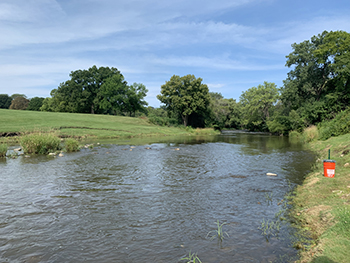
One of two study sites along the Root River, pictured in the summertime. (Submitted photo)

What the SEWRPC observation needed was better testing, and Paradis was eager to dig further. He needed high-frequency samples of chloride and flow measurements at multiple locations along the Root River in the summer. That’s where graduate student Dechant and the undergraduates have been a major asset.

Field sampling began in July 2021. From July to September, surface water samples were collected three days per week. Moving into the fall, sampling shifted into a biweekly mode using the same locations and procedures.

Half of the samples undergo high-level isotopic and chemical analysis by Timothy Wahl, an associate investigator on the project, at the UWM School of Freshwater Sciences. The other half of the samples are subject to benchtop pH and alkalinity low-level testing in the Paradis lab.

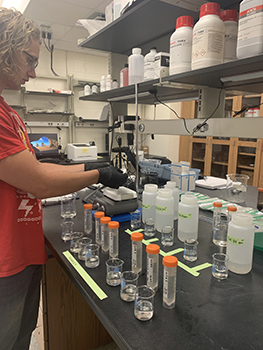
UW-Milwaukee undergraduate Dylan Childs prepares water samples for analysis in the lab. (Submitted photo)

For Dylan Childs, one of the undergraduates who has worked on the project, the process has been rewarding. “’I’ve really come to enjoy the scientific method and research in general,” he said. “This was probably the first research project where I got to go out in the field, and it was a lot of fun having that hands-on experience, as well as going in to the lab, too. I felt so much more involved.”

Added Childs, a senior geology major from Stoughton, “Having this additional research experience as an undergrad has definitely helped me home in on what I want to do with my future.” Undergraduates Autumn Routson and Samuel Sellars have also contributed to the project.

In addition to people power, the research is aided by technology. United States Geological Survey (USGS) gauging stations are located at the study sites. These stations beam publicly accessible data, including flow data, to the internet. Continuous monitoring devices on loan from SEWRPC have also helped; these record temperature, conductivity—a proxy for chloride—and depth round the clock.

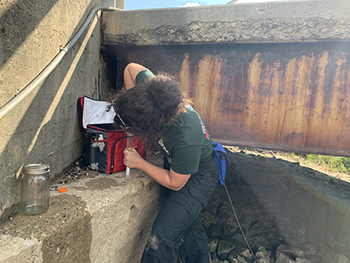
In the field, UW-Milwaukee graduate student Leah Dechant works with water samples collected from the Root River. (Submitted photo)

Through data collected from the USGS gauging stations, the loaned monitoring devices and water samples collected in the field, the team is capturing a much richer picture of what’s actually happening in the Root River. Paradis has noted that chloride concentrations in the river water have remained relatively constant—even when flow has increased and one might expect to see dilution as a result. This lends credence to the hypothesis that chloride is being stored in groundwater, providing a continuous source.

While almost a year and half of the project period still remains, Dechant will present the team’s findings so far in a poster session at this year’s conference for the Wisconsin Section of the American Water Resources Association (AWRA), which will take place March 10-11.

The post UW-Milwaukee researchers examine road salt’s year-round impact on Wisconsin rivers first appeared on WRI.

Original Article

News Release | WRI

News Release | WRI

https://www.wri.wisc.edu/news/uw-milwaukee-researchers-examine-road-salts-year-round-impact-on-wisconsin-rivers/

Jennifer Smith

In some states, the Department of Natural Resources offers an annual seed collection program. Anyone with a dry container can collect pine cones and seeds from trees and redeem them at listed nurseries for cash. The program is available in Indiana, Michigan, Minnesota and Wisconsin. Requirements for collection vary by state and species, but all seeds must be collected from trees of natural origin, not planted.

The post Backyard clean-up brings big bucks first appeared on Great Lakes Echo.

Original Article

Great Lakes Echo

Great Lakes Echo

http://greatlakesecho.org/2022/02/15/backyard-clean-up-brings-big-bucks/

Guest Contributor

Episode 1029: Great Lakes Now Floats My Boat

This lesson will introduce students to the phenomena of buoyancy and water displacement by  helping  them understand why a boat floats, learn about how boats have been made out of various materials—including wood—over the years, and engineer a boat according to certain constraints to hold a certain amount of weight.

Read Now at Great Lakes Now.

Original Article

Great Lakes Now

Great Lakes Now

https://www.greatlakesnow.org/2022/02/episode-1029-great-lakes-now-floats-my-boat/

Mila Murray

A Grand Rapids lake and the consequences of Michigan’s road salt addiction

By Kelly House, Bridge Michigan

The Great Lakes News Collaborative includes Bridge Michigan; Circle of Blue; Great Lakes Now at Detroit Public Television; and Michigan Radio, Michigan’s NPR News Leader; who work together to bring audiences news and information about the impact of climate change, pollution, and aging infrastructure on the Great Lakes and drinking water.

Read Now at Great Lakes Now.

Original Article

Great Lakes Now

Great Lakes Now

https://www.greatlakesnow.org/2022/02/grand-rapids-lake-road-salt/

Bridge Michigan

The Great Lakes Commission launched the Blue Accounting data portal on Feb.1. GLC Executive Director Erika Jensen says it’s a tool for elected leaders and decision-makers, but anyone can use it. Read and hear the full story by WDET – Detroit, MI.

Original Article

Great Lakes Commission

Great Lakes Commission

https://www.glc.org/dailynews/20220214-blue-accounting

Jill Estrada

Michigan coastal management projects, programs get $1.1M

HANCOCK, Mich. (AP) — More than $1.1 million in grants have been awarded to 17 coastal management projects and programs in Michigan.

Michigan’s Department of Environment, Great Lakes, and Energy says the funding will help protect, preserve, enhance and wisely develop the state’s coastal resources.

Recipients are located across Michigan and include $45,000 for Hancock to do a feasibility analysis for nature-based shore protection and restoration.

Read Now at Great Lakes Now.

Original Article

Great Lakes Now

Great Lakes Now

https://www.greatlakesnow.org/2022/02/ap-michigan-coastal-management/

The Associated Press

New sessions of Michigan’s NotMISpecies webinar series will cover how conservation officers help prevent invasive species introductions, as well as ways to enjoy the outdoors while minimizing harmful effects of invasive plants, animals and pests. Read the full story by the Daily Press.

Original Article

Great Lakes Commission

Great Lakes Commission

https://www.glc.org/dailynews/20220214-invasive-species

Jill Estrada

Clean Water and Air, LLC, filed a complaint accusing Tofte Wastwater Treatment Association (aka Bluefin Bay) of past and ongoing violations of the Clean Water Act (CWA), including the continued pollution of Lake Superior with “mercury, fecal matter, coliform, and suspended solids.”. Read the full story by Law Street Media.

Original Article

Great Lakes Commission

Great Lakes Commission

https://www.glc.org/dailynews/20220214-pollution

Jill Estrada

The White Earth band of Anishinaabe the largest of the six federally recognized Indigenous reservations that make up the Minnesota Chippewa Tribe, is fighting to prevent the line 3 pipeline from crossing wetlands used for harvesting native wild rice. Read and hear the full story by Canada’s National Observer.

Original Article

Great Lakes Commission

Great Lakes Commission

https://www.glc.org/dailynews/20220214-wild-rice

Jill Estrada

The world’s largest source of fresh water, the Great Lakes, provides drinking water to more than 40 million people in the U.S. and Canada. In the first study of its kind, researchers at the University of Wisconsin-Madison College of Engineering have demonstrated that tributary rivers feeding Lake Michigan play an important role in bringing the human-made group of chemicals known as per- and polyfluoroalkyl substances (PFAS) to the Great Lakes system.

Researcher Christy Remucal in her lab on the University of Wisconsin-Madison campus is analyzing water samples taken from known contamination sites, the Menominee and Peshtigo rivers, which feed into Lake Michigan. Photo: Bonnie Willison

Christy Remucal with the Department of Civil and Environmental Engineering, and postdoctoral co-investigator Sarah Balgooyen quantified 10 PFAS chemicals known as perfluoroalkyl acids (PFAAs), in the water and sediment of 41 tributaries to Green Bay of Lake Michigan.

The study is published in the Feb. 10, 2022, edition of the ACS ES&T Water Journal (https://pubs.acs.org/doi/full/10.1021/acsestwater.1c00348). It was funded by a grant from the Wisconsin Sea Grant College Program.

“Tributary PFAS loading to the Great Lakes is poorly understood,” Remucal said. “The role of sediments as a PFAS source or sink is also largely unknown. Our study is bringing some much-needed answers to not only the people who live around the bay of Green Bay, but also to all of the Great Lakes communities because it’s an interconnected water system. These findings could also be extrapolated to understand the conditions surrounding thousands of other tributaries that flow into the five lakes.”

PFAAs are found in common household items like cookware, cleaning agents and fabric treated with repellants, as well as in firefighting foams. In the study area, the Fox, Menominee and Peshtigo rivers contribute two-thirds of the total tributary PFAA loading to Green Bay despite their relatively low concentrations and despite the current regulatory focus on sites with high PFAA concentrations. The sources of the chemicals in the study tributaries are likely linked to a firefighting foam manufacturer, other industrial activity and airports, which use firefighting foam on runways.

In addition to the tributary discharge, the work showed that tributary sediments can contribute to PFAA via a releasing process known as desorption. Contaminated riverbed sediments may act as a PFAA source even if water concentrations are reduced by pollution mitigation.

Sarah Balgooyen, a postdoctoral investigator of PFAS, said there are likely more than 5,000 compounds known as per- and polyfluoroalkyl substances. In research published today in a leading journal Balgooyen quantifies 10 of the chemicals analyzed in the water and sediment of Lake Michigan tributary water bodies. Photo: Bonnie Willison

“Understandably, there is a heightened interest in the levels of PFAS in drinking water. PFAS have been linked to a number of ill human health effects, including cancer,” Balgooyen said. “I’m grateful for the opportunity to share my research. It certainly leads to a clearer understanding and, hopefully, can provide some guidance on contamination cleanup.”

The research will also inform the Wisconsin PFAS Action Council, of which Remucal is a member as the University of Wisconsin System representative. She is joined by representatives from 17 state agencies. The group has identified eight PFAS priority themes, including one on sampling and one on research and knowledge.

A video about this project can be found here.


The post Great Lakes tributary rivers play important role in bringing PFAS to the drinking water source of millions first appeared on Wisconsin Sea Grant.

Original Article

News Releases | Wisconsin Sea Grant

News Releases | Wisconsin Sea Grant

https://www.seagrant.wisc.edu/news/great-lakes-tributary-rivers-play-important-role-in-bringing-pfas-to-the-drinking-water-source-of-millions/?utm_source=rss&utm_medium=rss&utm_campaign=great-lakes-tributary-rivers-play-important-role-in-bringing-pfas-to-the-drinking-water-source-of-millions

Moira Harrington

By Hope O’Dell Capital News Service In the age of Uber and Lyft, public transportation is still the only viable option for many Michigan residents. “Sometimes on the weekend, or if you catch the right person, you might be able to grab an Uber, but it’s not regular service like that,” said Kelly Getman-Dissette, the […]

The post Dial-a-ride services struggle with driver shortage first appeared on Great Lakes Echo.

Original Article

Great Lakes Echo

Great Lakes Echo

http://greatlakesecho.org/2022/02/14/dial-a-ride-services-struggle-with-driver-shortage/

Guest Contributor

...ANOTHER VERY COLD NIGHT ACROSS NORTHEAST WISCONSIN... An arctic air mass remains over northeast Wisconsin tonight which will lead to very cold temperatures. Low temperatures are expected to be the coldest across north-central Wisconsin with readings in the teens below zero, with readings ranging from the single digits above and below zero across the rest of the area.

Original Article

Current Watches, Warnings and Advisories for Brown (WIC009) Wisconsin Issued by the National Weather Service

Current Watches, Warnings and Advisories for Brown (WIC009) Wisconsin Issued by the National Weather Service

https://alerts.weather.gov/cap/wwacapget.php?x=WI1263E29D5A78.SpecialWeatherStatement.1263E29ECC00WI.GRBSPSGRB.3b77a733acfe35fc01f412b80021d336

w-nws.webmaster@noaa.gov

...ANOTHER VERY COLD NIGHT ACROSS NORTHEAST WISCONSIN... An arctic air mass remains over northeast Wisconsin tonight which will lead to very cold temperatures. Low temperatures are expected to range from zero to 5 above near Lake Michigan, to the teens below zero across north-central Wisconsin. Winds are forecast to be light overnight into early Sunday morning

Original Article

Current Watches, Warnings and Advisories for Brown (WIC009) Wisconsin Issued by the National Weather Service

Current Watches, Warnings and Advisories for Brown (WIC009) Wisconsin Issued by the National Weather Service

https://alerts.weather.gov/cap/wwacapget.php?x=WI1263E290EE00.SpecialWeatherStatement.1263E29D6C70WI.GRBSPSGRB.3b77a733acfe35fc01f412b80021d336

w-nws.webmaster@noaa.gov

...ARCTIC AIR EXPECTED THIS WEEKEND... An arctic air mass is expected to settle over the region this weekend. This cold air will freeze any lingering water or slush on area roads tonight and produce icy spots, especially over central and east-central Wisconsin. Motorists should use caution and slow down as black ice is difficult to see at night.

Original Article

Current Watches, Warnings and Advisories for Brown (WIC009) Wisconsin Issued by the National Weather Service

Current Watches, Warnings and Advisories for Brown (WIC009) Wisconsin Issued by the National Weather Service

https://alerts.weather.gov/cap/wwacapget.php?x=WI1263E28E6658.SpecialWeatherStatement.1263E28F89C0WI.GRBSPSGRB.3b77a733acfe35fc01f412b80021d336

w-nws.webmaster@noaa.gov

...ARCTIC AIR EXPECTED THIS WEEKEND... An arctic air mass is expected to settle over the region this weekend. This cold air will freeze any lingering water or slush on area roads tonight and produce icy spots, especially over central and east-central Wisconsin. Motorists should use caution and slow down as black ice is difficult to see at night.

Original Article

Current Watches, Warnings and Advisories for Brown (WIC009) Wisconsin Issued by the National Weather Service

Current Watches, Warnings and Advisories for Brown (WIC009) Wisconsin Issued by the National Weather Service

https://alerts.weather.gov/cap/wwacapget.php?x=WI1263E28DB5C8.SpecialWeatherStatement.1263E28E7850WI.GRBSPSGRB.3b77a733acfe35fc01f412b80021d336

w-nws.webmaster@noaa.gov

THIS WEEK: Next Week: Join Us for the All About Water Symposium on Feb 17th; Join the Q&A Projects Grants Webinar on Feb 22nd; Have Your Voice Heard on Michigan’s Draft Healthy Climate Plan; First Nations $8-Billion Class-Action Settlement; Ontario Government Plans to Build New Highways Through Provincial Greenbelt 


Next Week: Join Us for the All About Water Symposium on Feb 17th!

Freshwater Future and All About Water are excited to share a space with you to join experts, peer groups and municipal officials to learn about federal dollars coming to states for water infrastructure projects. By participating you will gain valuable information about how your municipality can benefit from available federal funding to help replace lead lines, update water and wastewater treatment plants, utilize green infrastructure to prevent or reduce flooding, and more. REGISTER NOW! Thursday, February 17th, 9:30 am – noon EST.


Need Funds for Your Water Work? Join the Q&A Projects Grants Webinar on Feb 22nd

Freshwater Future has been fortunate to provide Grant Programs for grassroots community organizations for over 26 years. Learn more about our Grants Program on Tuesday, February 22nd– noon (EST). To register online, please click HERE. To register by email or phone, please contact laurie@freshwaterfuture.org, (231)348-8200. Also, visit the grant map on our website to learn more about our Grant Programs funding initiatives and HERE for our grant Request for Proposals.


Have Your Voice Heard on Michigan’s Draft Healthy Climate Plan

Michigan recently released a draft MI Healthy Climate Plan focused on reducing greenhouse gas emissions. Public input and feedback on the plan can be submitted verbally at two remaining listening sessions:

February 14, 2022 from 6:00 to 8:00 pm, Focus on Environmental Justice – Register Here

Written comments can be submitted until March 14, 2022 to EGLE-ClimateSolutions@Michigan.gov.


First Nations $8-Billion Class-Action Settlement 

Members of Canadian First Nations who have been affected by drinking water advisories for years will be compensated in what one chief called a “historic moment” for First Nations in Canada. Neskantaga First Nation and Curve Lake First Nation in Ontario, along with Tataskewyak Cree Nation in northern Manitoba, started a class-action lawsuit against the federal government over long-term drinking water advisories. The agreement includes an infrastructure commitment of at least $6 billion to support access to safe drinking water on reserves and $1.5 billion in compensation to individuals deprived of clean drinking water.


Ontario Government Plans to Build New Highways Through Provincial Greenbelt 

Planning for two new highways, Highway 413 and the Bradford Bypass, is underway.  While the provincial government claims that the highways are needed to reduce commute times through the Greater Toronto Area, conservation organizations and many local communities (including Toronto, Markham, and Vaughan) are opposed to the proposed highways.  The proposed routes are through the Greenbelt and will have potential impacts on fish and wildlife habitat, water quality and will increase greenhouse gas emissions.    The provincial environmental assessment process has been streamlined and there are concerns that environmental issues are not being adequately considered and addressed.  Additionally, there have been concerns with the consultation process.

Original Article

Blog – Freshwater Future

Blog – Freshwater Future

https://freshwaterfuture.org/freshwater-weekly/freshwater-future-weekly-february-11-2022/

Alana Honaker

...ARCTIC AIR EXPECTED THIS WEEKEND... An arctic air mass is expected to settle over the region this weekend. This cold air will freeze any water on area roads tonight and produce icy spots, especially over central and east-central Wisconsin. By late tonight, wind chills will drop to 15 below to 20 below zero across most of central, north-central, and far

Original Article

Current Watches, Warnings and Advisories for Brown (WIC009) Wisconsin Issued by the National Weather Service

Current Watches, Warnings and Advisories for Brown (WIC009) Wisconsin Issued by the National Weather Service

https://alerts.weather.gov/cap/wwacapget.php?x=WI1263E2818960.SpecialWeatherStatement.1263E28DB500WI.GRBSPSGRB.3b77a733acfe35fc01f412b80021d336

w-nws.webmaster@noaa.gov

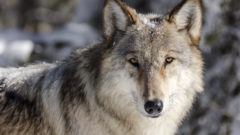
Judge restores protections for gray wolves across much of US

By Matthew Brown and John Flesher, Associated Press

BILLINGS, Mont (AP) — A judge restored federal protections for gray wolves across much of the U.S. on Thursday, after their removal in the waning days of the Trump administration exposed the predators to hunting that critics said would undermine their rebound from widespread extermination early last century.

Read Now at Great Lakes Now.

Original Article

Great Lakes Now

Great Lakes Now

https://www.greatlakesnow.org/2022/02/ap-judge-protections-gray-wolves/

The Associated Press