It’s May in the Winnebago area, which means everyone’s favorite mother’s day tradition is back: Lake Flies (Chironomids)! These non-biting midges typically hatch around Mother’s Day in late May, though this time frame can shift depending on winter conditions. A second, smaller hatch of lake flies often occurs in late summer.

Lake flies seen around Lake Winnebago are a collection of different midge species, the most numerous likely Chironomus plumosus, also known as the buzzer midge. During the large May hatch, you can easily tell how this species got their common name – there is a low hum from the sheer number of the midges.
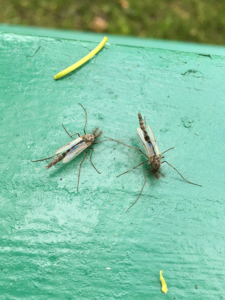
Alexsuchy - CC BY-SA 4.0

These flies have wing lengths around 6 mm, and bodies as long as 13 mm. When they emerge to create mating swarms, adults live for only 3 – 11 days. Since they do not have functional mouthparts, they do not bite or even eat! The location and size of swarms are highly dependent on the wind, and are often concentrated on areas that contrast with the background. Females lay masses of eggs on the water surface, which then absorb water and sink to the lake bottom. These eggs hatch shortly after and become midge larvae. The larvae undergo 4 stages, the first of which is free swimming. During the following three stages, the larvae make and live in a tube, collecting food at the bottom of the lake. Then the lake flies emerge in May or late summer and start the cycle over again.

Many species eat lake fly larvae and adults are therefore very important for the food web in Lake Winnebago. In fact, lake fly larvae help support the sturgeon population and contribute to our large self-sustaining lake sturgeon population. Other fish species eat the larvae stages and birds including purple martins and warblers eat the flying adults. Though the large hatching event can be a nuisance for us, they are critical for the food webs of the Winnebago Lakes. Remember, though they can be very annoying, they only last about 2 weeks! Their impact on the rest of the system lasts for much longer.

Winnebago Waterways is a Fox-Wolf Watershed Alliance recovery initiative. Contact us at wwinfo@fwwa.org

The post Species Spotlight: Lake Flies! appeared first on Fox-Wolf Watershed Alliance.

Original Article

Fox-Wolf Watershed Alliance

Fox-Wolf Watershed Alliance

https://fwwa.org/2023/05/25/species-spotlight-american-white-pelican-2/?utm_source=rss&utm_medium=rss&utm_campaign=species-spotlight-american-white-pelican-2
Katie Reed

Original Article

Fox-Wolf Watershed Alliance

Fox-Wolf Watershed Alliance

https://fwwa.org/2023/05/23/build-your-own-rain-barrel-workshop-june-17th-2023/?utm_source=rss&utm_medium=rss&utm_campaign=build-your-own-rain-barrel-workshop-june-17th-2023

Alyssa Reinke

Ensuring Your Water Garden Doesn’t Harbor Invasive Plants

As you’re choosing your plants for your water gardens and backyards this spring, be sure you aren’t accidentally growing an invasive plant that could do harm to our lakes and rivers! But don’t take our word for it! Here’s some tips from Melinda Myers, nationally known gardening educator, horticulturist, arborist, author, speaker, and TV/radio host with more than 30 years of horticulture experience!

Questions? Comments? Contact Chris Acy, the AIS Coordinator covering Brown, Outagamie, Fond du Lac, Calumet, and Winnebago Counties at (920) 460-3674 or chris@fwwa.org!

Follow the Fox Wolf Watershed Alliance’s Winnebago Waterways Program on our Winnebago Waterways Facebook page or @WinnWaterways on Twitter! You can also sign-up for email updates at WinnebagoWaterways.org.

Winnebago Waterways is a Fox-Wolf Watershed Alliance program. The Fox-Wolf Watershed Alliance is an independent nonprofit organization that identifies and advocates effective policies and actions that protect, restore, and sustain water resources in the Fox-Wolf River Basin.

Check out the Keepers of the Fox Program at https://fwwa.org/watershed-recovery/lower-fox-recovery/

Reporting invasive species is a first step in containing their spread. Maintaining and restoring our waters and landscapes can reduce the impacts even when we don’t have other management options to an invasive species.

The post What’s That Plant? Know What’s In Your Water Garden appeared first on Fox-Wolf Watershed Alliance.

Original Article

Fox-Wolf Watershed Alliance

Fox-Wolf Watershed Alliance

https://fwwa.org/2023/05/11/whats-that-plant-know-whats-in-your-water-garden/?utm_source=rss&utm_medium=rss&utm_campaign=whats-that-plant-know-whats-in-your-water-garden

Chris Acy

Thank you to the Wisconsin Herd, Oshkosh Arena, and Winnebago County and the Winnebago Solid Waste Department for having the Winnebago Waterways Program as the non-profit of the night at the Wisconsin Herd Game on March 17, 2023. It was an exciting game and thanks to all who bid on the Go Green jerseys following the game, we raised $1650.57! These funds will be used to further our water quality restoration and protection efforts. Thank you for all your support!

The post Total raised as a result of Go Green night at the Wisconsin Herd Game March 17, 2023 appeared first on Fox-Wolf Watershed Alliance.

Original Article

Fox-Wolf Watershed Alliance

Fox-Wolf Watershed Alliance

https://fwwa.org/2023/04/27/wisconsin-herd-march-17-result/?utm_source=rss&utm_medium=rss&utm_campaign=wisconsin-herd-march-17-result

Katie Reed

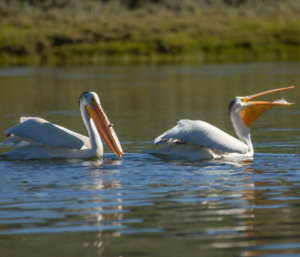
The American White Pelican (Pelecanus erythrorhynchos) used to be a rare sight in Wisconsin, now these birds, with wingspans up to 9 feet, are frequently spotted in large numbers in the Winnebago System! The American White Pelican has an orange, long, pouched bill (beak) that can grow a protrusions during the breeding season. The tips of their bills have a small hook at the tip. Their necks are long, and their bodies are usually snowy white with black flight feathers. Their legs and feet are orange though younger birds’ can appear more gray-pink and darken with age, and their feet are webbed. Adult pelicans can weigh about 16 pounds, making them one of the heaviest flying bird species.

American White Pelicans are piscivorous, meaning they primarily eat fish. The American White Pelican forages for food mostly in shallow waters in open areas of marshes, lakes, rivers, and ponds but can forage in deeper water. American White Pelicans do not submerge or dive for food. Instead, they dip their bill into the water and scoop up prey into their pouch, then tip their bill above their head to swallow. A typical pelican can reach down to about 3 feet below the surface of the water, and can eat about 3 pounds of fish a day! In Wisconsin, pelicans have been recorded eating common carp, as well as other fish species. They can also eat amphibians like frogs and invertebrates like crayfish. Pelicans sometimes work together to forage for food. A group of pelicans can corral fish into shallow areas or to the center of a U formation or circle to more easily catch prey.

Adult American White Pelicans on Water (National Park Service)

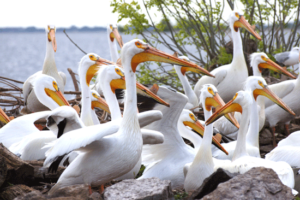
Pelicans at a nesting colony (Winnebago Waterways User Submitted Photo)

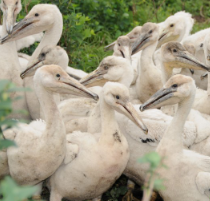
Young Pelicans (USDA)

Pelicans start to breed when they reach about 3-6 years old and travel to their breeding colonies in March – May. These colonies are typically on islands. Nests are built on the ground in colonies with other pelicans, as well as other bird species like cormorants and gulls. Usually pelicans lay 2 eggs. The eggs and hatched young are vulnerable to predators like eagles, foxes, and raccoons. Studies show that pelicans can live up to 30 years.

Historically, American White Pelicans were found in Wisconsin but their population sharply declined in the late 1800s – 1900s due to hunting and habitat loss. In the last 20-25 years, their populations have grown tremendously in Wisconsin, prompted likely by loss of breeding grounds in the West but also due to habitat restoration projects and pollution cleanup. In the lower Green Bay area, the number of white pelicans grew from about 250 in 2005 to more than 3,000 in 2021. Protecting their habitat and water quality is important to their continued success in the Winnebago System.

Winnebago Waterways is a Fox-Wolf Watershed Alliance recovery initiative. Contact us at wwinfo@fwwa.org

The post Species Spotlight: American White Pelican appeared first on Fox-Wolf Watershed Alliance.

Original Article

Fox-Wolf Watershed Alliance

Fox-Wolf Watershed Alliance

https://fwwa.org/2023/04/26/species-spotlight-american-white-pelican/?utm_source=rss&utm_medium=rss&utm_campaign=species-spotlight-american-white-pelican

Katie Reed

Lifetime Business Member of Fox-Wolf Watershed Alliance.

A huge thank you to Rob and his team at Motto Inc. (pictured above), a locally owned and operated business, for their continued support of Fox-Wolf Watershed Alliance’s water quality initiatives in the Winnebago Waterways Recovery Area. Last year, Motto Inc. donated $18,262 to Fox-Wolf Watershed Alliance. This year they beat their own record by donating $25,000! Their donation will have an even bigger impact because a percentage was matched by the Greater Green Bay Community Foundation’s Give Big Green Bay program.

In addition to their generous donation, Motto Inc. has volunteered with Fox-Wolf Watershed Alliance. Last winter, the Motto Inc. team volunteered to sow native plants and take care of them over the winter. These plants will be used in our shoreline restoration projects!

Motto Inc. is also a business member of 1% for the Planet, which connects businesses and individuals who pledge to give 1% of their sales back to the planet each year with approved environmental nonprofits around the world. This partnership will help Fox-Wolf Watershed Alliance connect with more businesses who share the same values of promoting water quality and environmental stewardship.

Motto Inc. lives up to their commitment through quality branded products and their ongoing support of various causes that improve the community and environment. We invite you to learn more about this local business by visiting their website: www.mottoinc.com

Thank you to Rob and his Motto Inc. team for their continued support!

The Winnebago Waterways Program facilitates regional coordination and implementation of recovery efforts for the Winnebago Lakes and surrounding watersheds. Priority implementation projects are outlined in the Winnebago Waterways Lake Management Plan. Winnebago Waterways is a program of the Fox-Wolf Watershed Alliance. The Fox-Wolf Watershed Alliance is an independent non-profit organization that works to protect and restore the water resources of the Fox-Wolf River Basin. We are focused on finding cost effective, science-based solutions. To meet our goals, we work with partners to maximize efficiencies, bringing resources to those who are already doing great work while utilizing our strengths to fill gaps when needed.

About 1% for the Planet

1% for the Planet is a global organization that connects dollars and doers to accelerate smart environmental giving. Through business and individual memberships, 1% for the Planet inspires people to support environmental organizations through annual membership and everyday actions. The organization advises on giving strategies, certifies donations and amplifies the impact of the network.

Started in 2002 by Yvon Chouinard, founder of Patagonia, and Craig Mathews, founder of Blue Ribbon Flies, their members have given more than $250 million to environmental nonprofits to date. Today, 1% for the Planet is a network of more than 3,000 business members, an expanding core of individual members and thousands of nonprofit partners in more than 90 countries.

If you are interested in learning more about 1% for the Plant and how to become a business partner, please contact Korin at korin@fwwa.org.

Questions? Comments? Send us an email at wwinfo@fwwa.org.

Follow the Fox Wolf Watershed Alliance on social media: Winnebago Waterways on Facebook and @WinnWaterways on Twitter!

Winnebago Waterways is a Fox-Wolf Watershed Alliance program. The Fox-Wolf Watershed Alliance is an independent nonprofit organization that identifies and advocates effective policies and actions that protect, restore, and sustain water resources in the Fox-Wolf River Basin.

The post Local Business Continues Support of Water Quality Initiatives appeared first on Fox-Wolf Watershed Alliance.

Original Article

Fox-Wolf Watershed Alliance

Fox-Wolf Watershed Alliance

https://fwwa.org/2023/04/26/local-business-continues-support-of-water-quality-initiatives/?utm_source=rss&utm_medium=rss&utm_campaign=local-business-continues-support-of-water-quality-initiatives

Katie Reed