By Vivian La, IPR

This story is made possible through a partnership between Interlochen Public Radio and Grist, a nonprofit environmental media organization.


As Michigan faces an aging farmer population, communities are looking for ways to shore up the next generation of growers. But people looking to get in the field face challenges like high costs, access to land and a shifting climate.

Tucked on farmland at the southern edge of Traverse City, one program wants to solve some of these problems by letting aspiring farmers learn by doing.

The Great Lakes Incubator Farm attracts students from all over the country. Over the course of seven months, they learn topics like pest management, how to drive a tractor and what to include in a farm business plan.

“Nobody gets into farming for sane reasons, other than the sanity of knowing where your food comes from and just general health,” said 33-year-old Rachel Greenberg, a student farmer from Indianapolis. “The challenges are pretty never-ending.”

Those challenges include high costs, access to land and volatile weather. Farm bankruptcies last year were up 46% nationally, according to a National Farm Bureau report. As land prices rise due to demand from developers, more than 50,000 acres of farmland has been lost in the last two decades, according to research.

Despite headwinds, the student farmers said they’re driven by wanting to know where their food comes from, to contribute to local communities and teach others to do the same.

‘Pay it forward’

The farm training program — a project of the Grand Traverse Conservation District — has fewer economic pressures than running a farm business, Greenberg said. The fruits and vegetables that students grow will go to locals who have already committed to buying the season’s produce, and leftovers will go to food rescue operations. Unlike a traditional business, the goal isn’t to make a profit.

“The whole incubator idea is something you see a lot in the world of entrepreneurship, and it’s beautiful that somebody saw that and was like, ‘Why don’t we just do that with farming?’” Greenberg said.

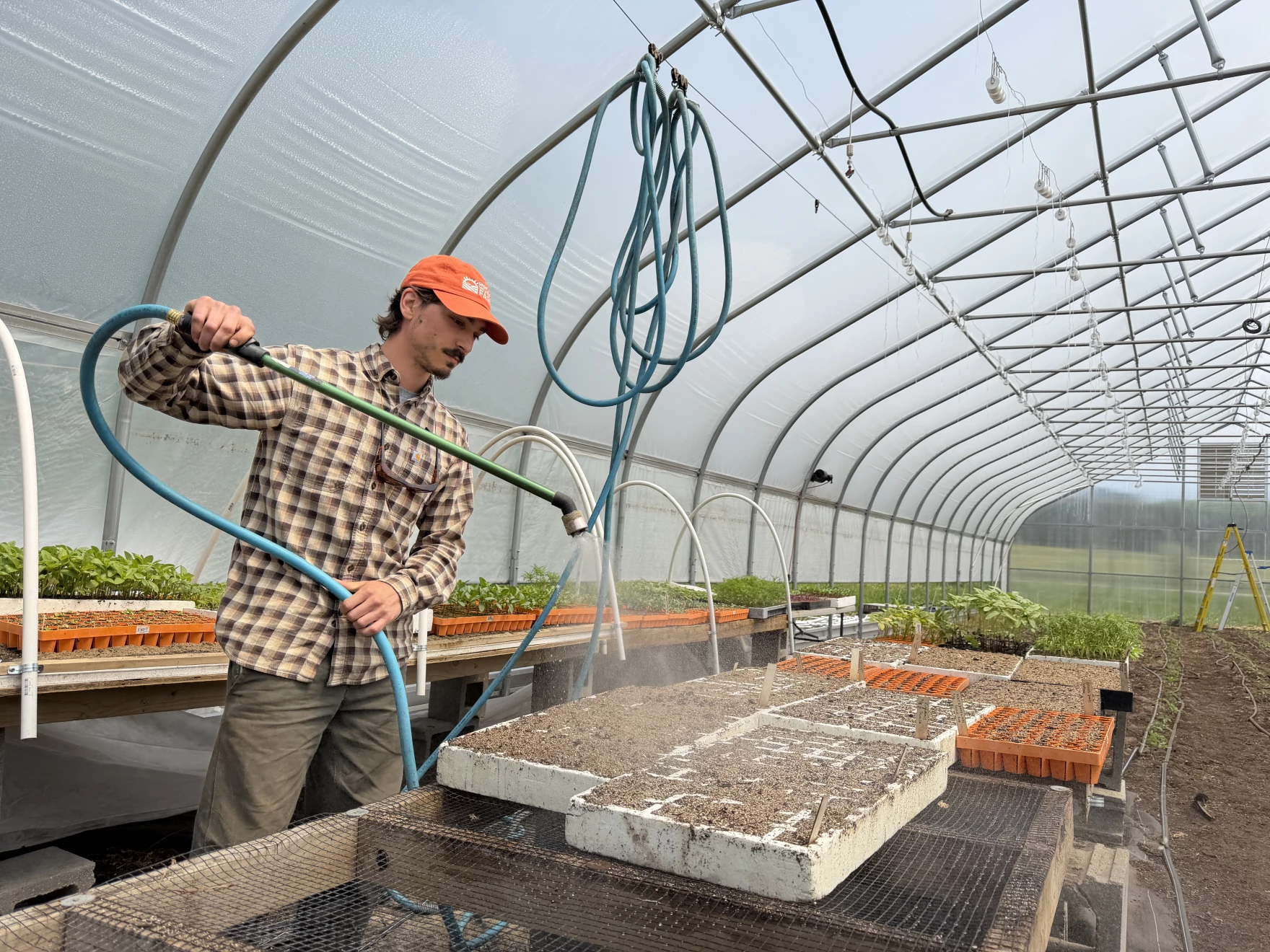
Troy Saruna, 28, said at a time where climate change is driving more severe weather, he wants to better understand his impact on the natural world. Saruna worked in conservation around the country prior to the program, and has no farming experience.

Student farmer Troy Saruna waters seedlings in the greenhouse at the Great Lakes Incubator Farm. (Photo credit: Vivian La/IPR News)

The training program focuses on teaching regenerative agriculture, which refers to practices that could reduce the pollution causing climate change by improving soil health.

“Our food systems are just so inextricably tied to the health of the planet,” Saruna said. “I’m just really interested in striking up a new balance where I can understand, interpret and just develop some new instincts in terms of feeding myself and having thriving communities that also support wildlife.”

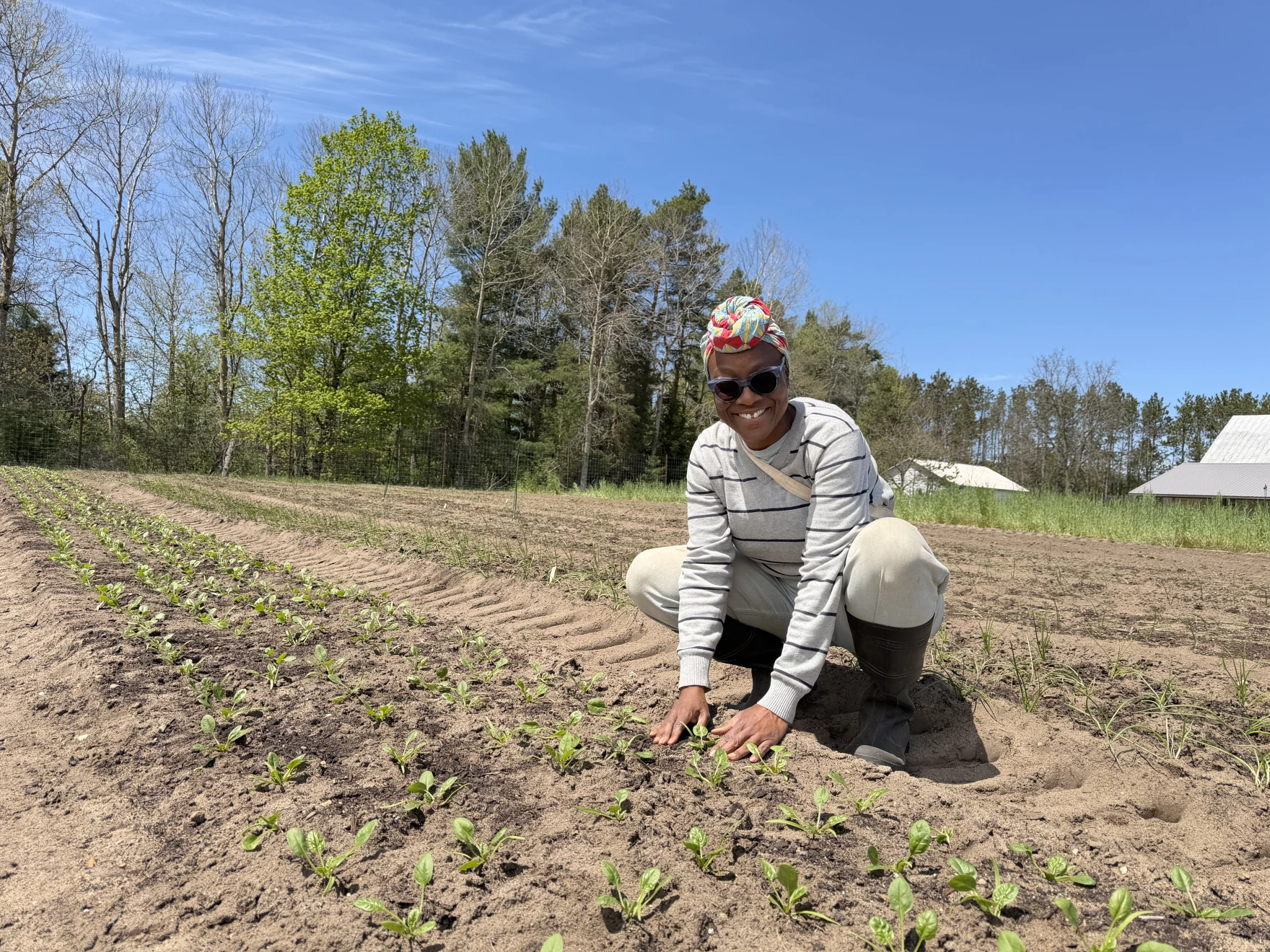
Farmers with some experience also find the program helpful to dive deeper into certain skills. Shanaya Holmes, 49, runs a small 4-acre farm in Alabama.

Student farmer Shanaya Holmes kneels by a row of spinach. (Photo credit: Vivian La/IPR News)

She’s looking to learn how to grow in a different climate and to improve her record keeping — tracking what’s been planted, what soil was used or how much money was spent on equipment.

“It’s a challenge to switch that button off to come inside and do bookwork, bookwork, bookwork when you’re so used to outside, outside, outside,” she said.

Adam Brown, the farm’s manager and instructor, said the farmer training program is meant to be a stepping stone.

“It’s really built for anybody who can then filter out and work anywhere in the food system, either manage a farm, start their own business, or any rung of that ladder where people can just help out in the food system,” Brown said.

Brown wouldn’t have pursued farming himself if it wasn’t for a similar training program he did 15 years ago on the West Coast. He has a background in ecology.

“I can pay it forward, my lessons, and all the wisdom that I learned throughout my years of farming, and be a mentor to these other people, and I feel like it’s super important,” he said.

Funding the future

The training program, now in its second year, is one of the only programs of its kind in northern Michigan, according to data from Michigan State University.

The Great Lakes Incubator Farm relies mostly on a nearly $700,000 federal grant from the U.S. Department of Agriculture aimed at supporting beginner farmers. That grant ends after this season and Brown plans to reapply for USDA funding this year.

Still, the agency is undergoing changes as it works to match the president’s priorities. Last year, the USDA canceled $148 million in grants — including some in the beginner farmer program — to comply with the president’s early executive orders targeting climate action, environmental justice, and diversity, equity, and inclusion.

Brown said there’s not many large pools of money like this USDA grant program that support efforts to train the next generation of farmers. The Great Lakes Incubator Farm is also supported by some state grants.

Adam Brown sits on a tractor at the Great Lakes Incubator Farm. He teaches students at the farm and says there needs to be more training programs like this to support an aging farmer population. (Photo credit: Vivian La/IPR News)

Lack of consistent funding is a big reason we don’t see more of these training programs, said Jon LaPorte, a farm business management educator for Michigan State University Extension.

“It’s almost like a double-edged sword that they’re trying to help people get started, but then they’ve got the same struggles of staying sustainable themselves,” he said.

That means as the share of young people in farming grows in Michigan, programs to support them might be harder to come by, LaPorte said. Farmers under the age of 45 increased by more than 3,000 people between 2017 and 2022, according to the USDA’s census. Sustaining that growth is a challenge.

“Because of those hurdles, they don’t all stay in, and what we want to see is more of those people being able to stay in, having more farms, more diversity of farms,” he said. “More people involved in agriculture at that level is really, really important.”

There are still resources available, said Katie Brandt, who leads MSU’s Organic Farmer Training Program in East Lansing. MSU Extension put together a beginner farmer’s guide in partnership with the USDA last year. And many farms across the state often accept volunteers for work, she said.

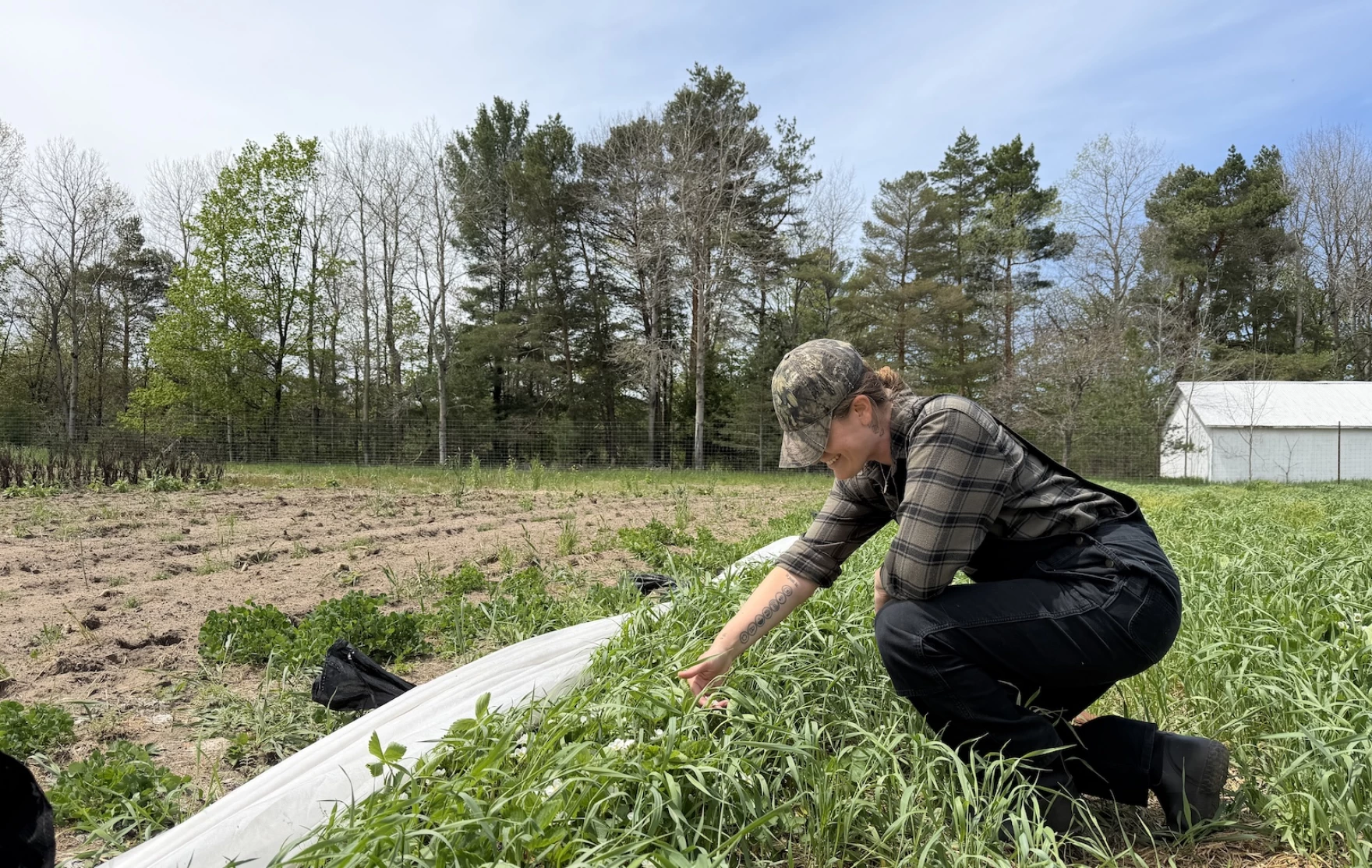
Brown, the farm manager, said students in the training program learn that the growing season doesn’t always go smoothly — and things like frost damage on plants is just part of the job.

“This is a great space for failure too, right? Because there’s not a whole lot of risk here,” he said. “It’s a perfect, experimental type of atmosphere.”


The post This northern Michigan program hopes to cultivate the next generation of farmers appeared first on Great Lakes Now.
Original Article

Great Lakes Now

Great Lakes Now

https://www.greatlakesnow.org/2026/05/29/this-northern-michigan-program-hopes-to-cultivate-the-next-generation-of-farmers/

Interlochen Public Radio and Grist

By Naveena Sadasivam

This story was originally published by Grist. Sign up for Grist’s weekly newsletter here.


Last month, President Trump sat alongside executives of the largest tech companies in the country as they pledged to pay a fair share of the energy costs of their data center buildout. “Data centers … they need some PR help,” Trump said at the gathering. “People think that if the data center goes in, their electricity is going to go up.”

It’s not an entirely unfounded assumption.

As the tech industry has funneled billions of dollars into the AI boom over the last several years, it has simultaneously been expanding its fleet of computing powerhouses, which require vast amounts of energy to run. These facilities have been cropping up all over the country, from rural communities in eastern Pennsylvania to the cities of northern Utah. 

This boom coincides with a dramatic rise in U.S. electricity prices, driven by inflation and the rising cost of adapting to wildfires, hurricanes, and other extreme weather. But these massive facilities have also strained the grid — and in some cases — contributed to rising prices. For instance, last year, an independent monitor for PJM, the grid operator that serves 13 northeastern states and Washington, D.C., projected that powering data centers would result in higher electricity generation costs, which would ultimately be passed on to consumers. And in cases where the buildout hasn’t yet led to price hikes, utilities and grid operators expect that it’s just a matter of time if tech companies follow through on their plans. Indeed, the Federal Reserve Bank of Dallas estimates that with data center electricity demand expected to double in the next five years, wholesale power prices could rise by as much as 50 percent.

At a time when the cost of living has become untenable for many Americans, and consumers are setting aside ever greater shares of their income to pay energy bills, the possibility of further rate hikes to line the pockets of tech companies has prompted a massive backlash across the country. The White House gathering of tech executives appeared to be a response to the backlash. On March 4 at the event, they signed onto the “Ratepayer Protection Pledge.”

The pledge itself has few specifics or teeth. It’s a voluntary agreement by several prominent tech companies — including Microsoft, Meta, OpenAI, and Amazon — to secure their own power for data centers, pay for any powerlines or other infrastructure that utilities may need to build to move that power, and hire locally from the communities they build in. While in theory the agreement could help prevent Americans from having to bear the cost of the data center expansion, the White House hasn’t set up oversight mechanisms to ensure that they do. Several consumer and environmental advocates called the agreement “meaningless,” “unenforceable,” and ultimately, “nonsense.”

The United States has become ground zero for the global data center boom. The rapid buildout has left developers, tech companies, and the utility industry scrambling to secure more power. As a result, the wait for a data center to connect to the grid can be years in many parts of the country. Hyperscalers — companies that operate large data centers and provide vast computing power — have been trying to get around these wait times by signing long-term power purchase agreements with solar developers, building their own natural gas plants, and even retrofitting jet engines to generate electricity

“Every single data center in the future will be power limited,” said NVIDIA CEO Jensen Huang last year. “We are now a power‑limited industry.”

Outside of the White House, utilities, local regulators, and lawmakers have also been proposing various solutions to address the community backlash and allow for the continued building of more data centers. Some have implemented measures requiring data centers to pay the costs of generating and moving the electricity they use. Others have suggested that data center developers install solar and battery systems on-site, or that rates should be frozen for residents while utilities figure out how to handle the additional costs. And at least 11 states are considering legislation to temporarily ban new data centers while their impact on electricity prices and other concerns are addressed.

“You’re seeing states try to move quickly,” said Meghan Pazik, a senior policy associate in Public Citizen’s climate program. But “every state’s going to have a different approach to how far they want to go on data centers.”  

Many states are utilizing additional tariffs for data centers and other customers that pull large amounts of power from the grid. These facilities — referred to as “large load customers” — are required to pay more to make up for the added infrastructure costs that come with supplying them, as well as the risk if they end up walking away from the project, which would leave consumers on the hook for the investments. More than 30 states have proposed or implemented measures of this sort. 

Some hyperscalers are changing their approaches, too. In Minnesota, Google inked a deal with Xcel Energy, the state’s largest investor-owned utility, to bring 1,900 megawatts of clean energy onto the grid. The company is fully funding wind turbines, solar panels, and battery storage, as well as the costs of grid infrastructure upgrades to serve its data centers. And in Louisiana, Meta signed a deal with Entergy to help fund the construction of seven natural gas plants, more than 200 miles of transmission lines, and battery systems, among other infrastructure upgrades.

A recent report from the Searchlight Institute, a policy think tank, argues that this piecemeal approach to regulating the tech industry misses an opportunity to fund a large-scale upgrade of the grid. Although the surge in demand has largely been framed as a looming crisis, the report contends that the boom also creates a rare policy window: a chance to modernize the country’s electrical system and make long-delayed investments needed for the clean energy transition.

Utilities make roughly $35 billion in investments in transmission infrastructure every year — far short of what’s actually needed. Electricity demand is projected to double or triple in the next 25 years. The Searchlight Institute report proposes creating a dedicated grid infrastructure fund to accelerate the expansion. Under the plan, hyperscalers would pay into the fund in exchange for speedy connections. Money from the fund would be directed to utilities and other companies to build out the system, prioritizing clean energy along the way. And consumer and environmental advocates, along with other policymakers, would oversee the process to ensure funds are being distributed equitably and serve the needs of the public. 

Such a mechanism would ensure increased investments in clean energy, rather than the natural gas projects many tech companies are currently backing, while protecting consumers from increases in electricity prices.

“The hyperscalers need power,” said Jane Flegal, a senior fellow at the Searchlight Institute and author of the report. “They have a ton of capital. And rather than letting them continue to cut these one-off deals with utilities, we’ve got to find a better way to take advantage of the potential upside here and avoid the downside of them basically building a secondary grid behind the existing grid that benefits only them.”


The post Data centers are straining the grid. Can they be forced to pay for it? appeared first on Great Lakes Now.

Original Article

Great Lakes Now

Great Lakes Now

https://www.greatlakesnow.org/2026/04/14/data-centers-are-straining-the-grid-can-they-be-forced-to-pay-for-it/

Grist