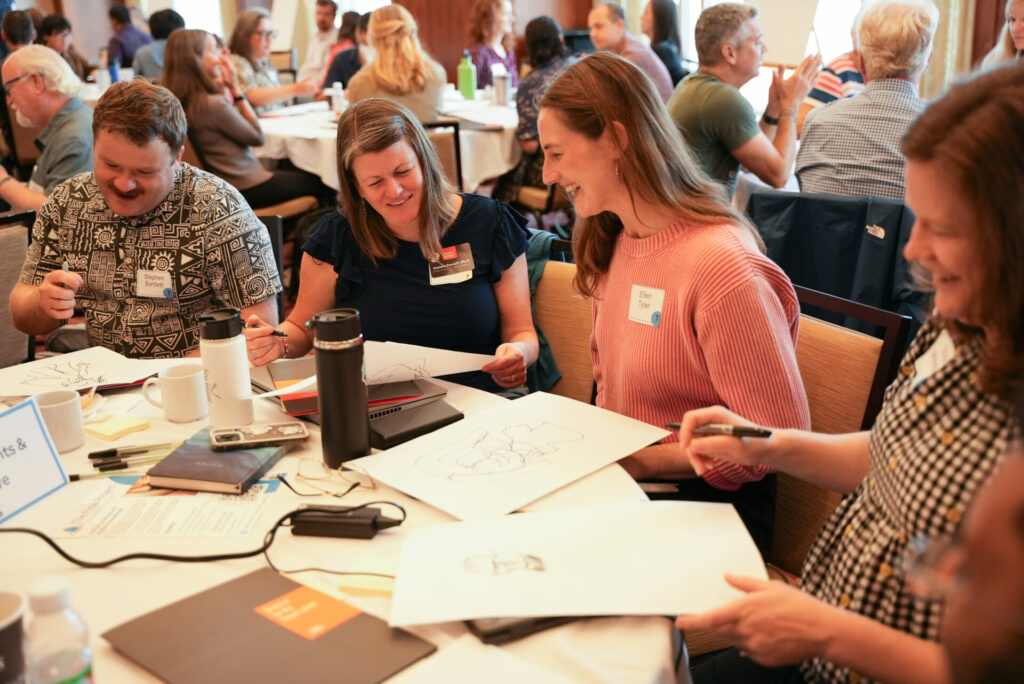
Participants at the Water Partnership Workshop talk and smile at a paper-strewn table

The Water Partnership Workshop gathered in September as part of an overall effort to turn scientific inquiry directly toward the priorities and needs of others, an approach known as community-engaged research. (Photo by Bonnie Willison / ASC)

By Alison Mikulyuk, Water@UW–Madison Research Program Coordinator, and Sarah Peterson, Community Engagement and Professional Development Manager

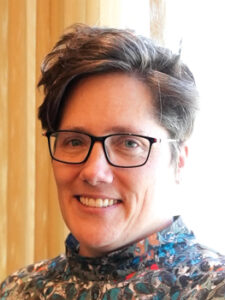
Alison Mikulyuk headshot

Alison Mikulyuk, Water@UW–Madison Research Program Coordinator (Photo by Bonnie Willison / ASC)

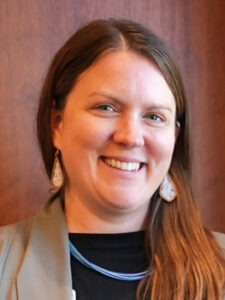
Sarah Peterson headshot

Sarah Peterson, Community Engagement and Professional Development Manager (Photo by Bonnie Willison / ASC)

Last fall, more than 70 water professionals, researchers, and community leaders gathered on the University of Wisconsin–Madison campus for the first-ever Water Partnership Workshop, hosted by Water@UW–Madison and Wisconsin Sea Grant. The energy in the room was apparent: conversations buzzed and ideas flowed freely as participants leaned into the opportunity to shape Wisconsin’s water future.

The lively discussion revolved around one question: What should we research — together — next?

This type of collaboration is a reflection of the growing desire to turn scientific inquiry directly toward the priorities and needs of others. Known as community-engaged research (CER), this approach centers community voices and fosters collaboration in science.

CER requires us to evaluate whether science is asking the right questions. Are research projects grounded in concerns and priorities shared by the community? Are researchers answering them in ways that are fair and useful? When done well, CER also helps build trust in science and the scientific process, empowers communities to take action and build strength, and can help democratize knowledge production so that more people have access and stand to benefit.

A growing number of scientists are inspired to participate in CER; however, many don’t know where to begin. In our roles at the Aquatic Sciences Center, we often hear the same question from scientists: How do I get started in a collaborative partnership with a community group?

Our attempts to answer that question led us to organize the Water Partnership workshop in September.

Matchmaking researchers with community partners

Designing the workshop took several months and started with brainstorming about how we as coordinators could help build relationships between campus researchers and community partners. Early on, we decided to offer a full-day workshop structured around a set of topics that scientists and community members wanted to tackle together. Our goal was to spark new connections, foster collaboration, and provide a space where community-engaged water research projects could begin to take shape. 

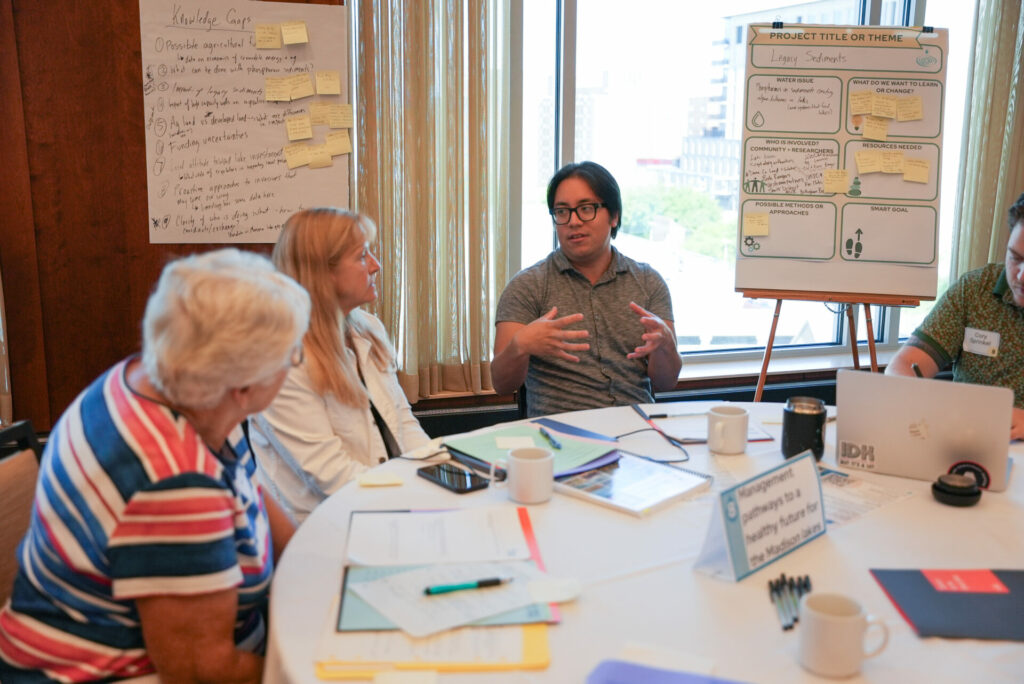
Three workshop participants discuss water quality around a round table.

Water professionals and community members discuss phosphorus in Madison-area lakes. (Photo by Bonnie Willison / ASC)

We reached out to over 40 contacts within Wisconsin’s diverse water network, who then reached out across their networks in turn. Participants were almost always excited about the opportunity to connect. After a series of one-on-one meetings with community representatives, we identified a collection of eight organizations eager to participate, each with their own unique concerns related to water. 

Behind the scenes, we began to match researcher expertise with the questions posed by community guests. As we recruited and aligned participants, we found ourselves creating a topic-specific seating chart that resembled something you’d see at a wedding reception. We aligned the participants on topic and interest, then balanced the groups to include experts and community members from a range of career stages and disciplines. 

The multigenerational, multidisciplinary groups that emerged set the stage for what we hoped would be a set of really interesting and productive conversations. 

Moving at the speed of trust

The eight groups that came together on September 11 arrived with a wide range of water topics that mattered to them. 

  • Representatives from the Wisconsin Farmers Union discussed agricultural trade-offs between organic and conventional practices. 
  • The Coon Creek Community Watershed Council explored ways of rethinking flood management to address aging dams throughout the watershed. 
  • Wisconsin EcoLatinos discussed culturally relevant communication about environmental contaminants in Latino communities. 
  • Representatives from the Black Earth Creek Watershed Association explored the impact of neonicotinoid pesticides on aquatic invertebrates in trout streams. 
  • Southern Wisconsin Trout Unlimited discussed the relationship between urban stormwater management and trout streams. 
  • A member of the Lac du Flambeau Band of Lake Superior Chippewa Indians spoke about tribal water rights and imagining ecology beyond a Western scientific framework. 
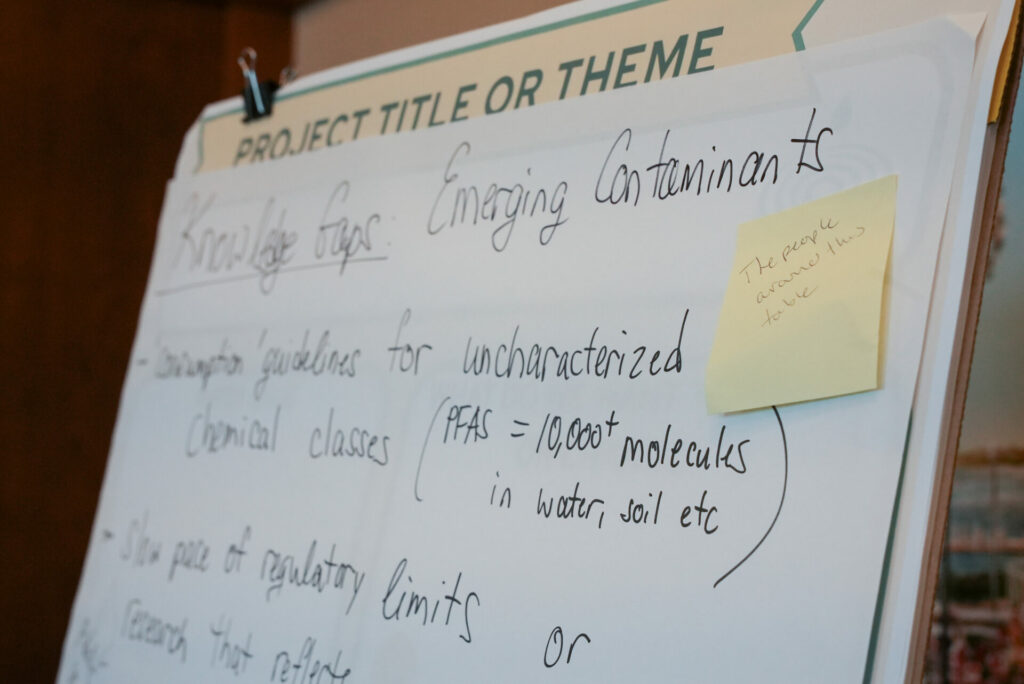
  • Staff from the Great Lakes Inter-Tribal Epidemiology Center engaged in a discussion on emerging contaminants and cumulative impacts to tribal communities across Wisconsin. 
  • Volunteers with two Madison-based lake associations spoke about phosphorus contamination and future management pathways. 

Over the course of six hours, the workshop revealed some cross-cutting challenges. One theme that surfaced was that scientific data and tools are often too complex for practical use. There was shared consensus that researchers must prioritize translating research into simple, actionable decision-support tools. 

Another theme spoke to how essential trust is for developing effective solutions, requiring two-way communication and the involvement of trusted community messengers. It highlighted how academic research operates at a certain pace, often driven by grant cycles, project management milestones or tenure review timelines. However, CER is not only in the hands of researchers, so it must always strive to move at what we’ve come to call the “speed of trust.”

Future collaborations

It’s our hope that we helped forge lasting connections that day. While we don’t know yet what will come of the projects and ideas that were generated, we know we’re learning more about a model by which to facilitate trust and exchange.

We hope that the Water Partnership Workshop was more than a one-day event — we envision it as a catalyst, demonstrating the power of bringing many voices together around shared water interests. We hope it helped lay groundwork for future collaborations that are community-initiated, interdisciplinary, and action-oriented.

We are already planning our next collaborative event, refining the model using feedback we received from participants. We strongly believe that this is what water research should look like: people coming together, listening deeply, honoring community agency, and building something better, together. If you’re interested, reach out to water@mailplus.wisc.edu to join us.

Notes collected on a large sticky note

Emerging contaminants were just one of the topics discussed at the workshop. (Photo by Bonnie Willison / ASC)

The post Researchers and communities working together first appeared on Wisconsin Sea Grant.
Original Article

News Releases | Wisconsin Sea Grant

News Releases | Wisconsin Sea Grant

https://www.seagrant.wisc.edu/news/researchers-and-communities-working-together/
Wisconsin Sea Grant

When summer stretches before many college undergraduates, they make plans: Spend time outdoors. Connect with friends. Catch up on screen time.

For the 31 undergraduates participating in the 2023 Freshwater@UW Summer Research Scholars Program, those plans are the same, with slight alterations. The time outdoors is likely to be spent collecting field samples from a body of water. The friends are new ones—made from the pool of program participants who hail from California to Alabama from Virginia to Wisconsin, and points in between. The screen time isn’t about beating The Legend of Zelda: Tears of the Kingdom, but instead entering findings into a larger dataset to further aquatic science projects.

Smiling person standing in a grassy, wooded area.

Sofia Mota Chichy will research magnesium oxide. Contributed photo.

“I looked at many summer REU (research experiences for undergraduates) opportunities,” Sofia Mota Chichy, chemistry major from the University of Michigan, said. “This one at Madison had the most in water chemistry and that’s what I am interested in. I’ve never worked in a chemistry lab before and it’s even better that it is an aquatic one.” Mota Chichy will be a part of University of Wisconsin-Madison’s Christine Remucal’s lab studying magnesium oxide.

A second young woman also expressed her attraction to this opportunity because of its emphasis on water. Plus, said Jessica Alcorn a student at Northwest Missouri State, “I want to go to graduate school here in Madison.” She’ll work under UW-Madison’s Matt Ginder-Vogel, who does both surface and groundwater research.

These springboards from research to a new path in life were celebrated by an enthusiastic Marissa Jablonski at a recent orientation session for the students. “Life will form you without you trying. You’re on your way. You’ve shown up. You’re leaning in.”

Jablonski is the executive director of the Freshwater Collaborative of Wisconsin, one of the funding entities for the summer program, about which, Sea Grant Director Jim Hurley said, “It’s been really positive to be able to expand our program because of support from the Freshwater Collaborative. Last year, we were a fledgling program of nine students.” Hurley secured a nearly $358,300 grant from the collaborative, resulting in this year’s larger cohort.

No matter the size of the group, though, Hurley said the goal remains unchanged, “The overall goal is to provide immersive student research experiences to enhance workforce development skills and allow undergraduates to consider the option of graduate studies in Wisconsin. Research experience as an undergraduate is an important component of a successful application for graduate school. In the job market, it also sets apart recent undergraduates who have addressed the changing needs of water-related fields.”

Large group of people in a grassy area.

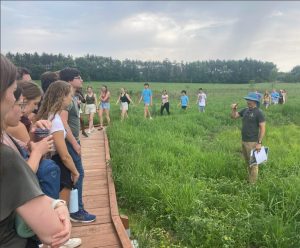
The 2023 cohort of summer research scholars undertook various orientation activities, including a tour of the UW-Madison Arboretum. Photo: Alison Mikulyuk

Expanding the number of participating students is one thing, another is the broadened involvement from professors, graduate students and others at organizations that are acting as mentors for the students. There are 48 in all, including people on University of Wisconsin System campuses in Eau Claire, Green Bay, La Crosse, Madison, Milwaukee and Oshkosh. Also providing formative experiences will be mentors from the U.S. Geological Survey, the Lake Superior National Estuarine Research Reserve, Wisconsin Shipwreck Coast National Marine Sanctuary and Wisconsin Maritime Museum.

In application materials, students this summer expressed interest in pursuing research into topics such as pollution, climate change, molecular structures of water, public health and more. The projects will deliver on that skill-building, spawning a new generation of water leaders. While the students will disperse across the state for these labs and field sites, they have a standing invitation to gather each Thursday virtually—and in-person if they are in Madison—for weekly professional development sessions on topics like science communication, navigating graduate school and proposal writing.

They will add these skills to their already prodigious ones in other areas that demonstrate well-rounded natures. At the orientation session, Alison Mikulyuk, summer research opportunity program coordinator, called out fun facts when she said among the group there was a proficient loon caller, a mushroom finder, dancers, an aspiring author, someone who graduated from high school as a 14-year-old, a boxer, world-medalist baton twirler, two twins, competitive swimmers, a multi-instrumentalist, many who play instruments and several who speak more than one language.

Mikulyuk urged the undergraduates to enjoy those skills of others, and also capitalize on the people who possess them, “Learn from each other. Care for each other…Take advantage of personal and professional connections.” She continued, “I hope you will have a life-changing experience that propels you forward in your next decades.”

The program will run until Aug. 5, culminating in a poster session where students will present their summer’s worth of findings.

In addition to the Freshwater Collaborative of Wisconsin and Sea Grant, the summer program has support from the University of Wisconsin Water Resources Institute, Water@UW Madison and the UW-Madison Graduate School.


The post Summer loving and the research is fine first appeared on Wisconsin Sea Grant.

Original Article

News Releases | Wisconsin Sea Grant

News Releases | Wisconsin Sea Grant

https://www.seagrant.wisc.edu/news/summer-loving-and-the-research-is-fine/?utm_source=rss&utm_medium=rss&utm_campaign=summer-loving-and-the-research-is-fine

Moira Harrington

In the late 1800s, the field of limnology (the study of lakes) had its birth in North America when what is now the University of Wisconsin-Madison’s Center for Limnology began its formative years.

Zoologists Edward Birge and Chancey Juday offered vision and leadership for this take on water science. They went heavy on field work and produced dozens of papers expounding lakes’ chemistry, biology and geology. They were committed to fostering student experiences and learning.

A thread of connection to those early days of freshwater study and student support carries through to today with the arrival at the Water Resources Institute (WRI)  and Sea Grant of Alison Mikulyuk, herself a graduate of that very same limnology program. She is the first-ever coordinator of Water@UW-Madison.

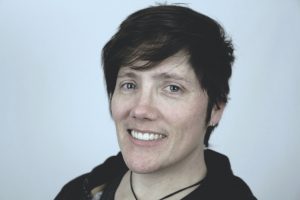
Closeup of smiling young woman with short dark hair.

“I’m excited to join the team at the Aquatic Sciences Center.” Mikulyuk continued, “I want to build and support a caring and connected network of water researchers, one that encourages exchange and innovation. I envision a healthy and productive collaborative group, where we work together across disciplines, across agencies and with communities to find new ways of asking and answering the questions that matter for fresh water.”

Water@UW-Madison had its own beginnings more than a decade ago when a handful of water scientists—including Jake Vander Zanden, the current director of the Center for Limnology—formed an organization to foster connections among students, staff and faculty with water interests and studies. The goal at the time, Vander Zanden said, was to facilitate greater interdisciplinary collaboration and exploration.

Water@UW-Madison sponsors a fall poster session, spring symposium, student mentoring, a summer undergraduate research experience and art and freshwater science collaborations. It hosts an informative website and during the academic year publishes a weekly newsletter. In sum, it pulls together and amplifies the water expertise of more than 130 faculty and staff across more than 40 departments and programs on the Madison campus.

It further strives to broaden its reach to other campuses in the University of Wisconsin System, along with private colleges, government agencies, non-governmental organizations and civil society in Wisconsin and beyond.

Mikulyuk will also support the WRI and Sea Grant research enterprise and the programs’ robust fellowship initiatives that place post-graduates in settings with state agencies, offering cutting-edge skills and knowledge to the agencies, along with mentoring, networking opportunities and experience for the fellows.

Additionally, she will also oversee the Freshwater@UW Summer Research Scholars Program, which pairs undergraduates with research mentors. The program is in its second year and 2023 opportunities are now available for application until Feb. 15.

The post Alison Mikulyuk will assist with WRI research competition first appeared on WRI.

Original Article

News Release | WRI

News Release | WRI

https://www.wri.wisc.edu/news/alison-mikulyuk-will-assist-with-wri-research-competition/?utm_source=rss&utm_medium=rss&utm_campaign=alison-mikulyuk-will-assist-with-wri-research-competition

Moira Harrington

In the late 1800s, the field of limnology (the study of lakes) had its birth in North America when what is now the University of Wisconsin-Madison’s Center for Limnology began its formative years.

Zoologists Edward Birge and Chancey Juday offered vision and leadership for this take on water science. They went heavy on field work and produced dozens of papers expounding lakes’ chemistry, biology and geology. They were committed to fostering student experiences and learning.

A thread of connection to those early days of freshwater study and student support carries through to today with the arrival at Sea Grant and the Water Resources Institute (WRI) of Alison Mikulyuk, herself a graduate of that very same limnology program. She is the first-ever coordinator of Water@UW-Madison.

Closeup of smiling young woman with short dark hair.

“I’m excited to join the team at the Aquatic Sciences Center.” Mikulyuk continued, “I want to build and support a caring and connected network of water researchers, one that encourages exchange and innovation. I envision a healthy and productive collaborative group, where we work together across disciplines, across agencies and with communities to find new ways of asking and answering the questions that matter for fresh water.”

Water@UW-Madison had its own beginnings more than a decade ago when a handful of water scientists—including Jake Vander Zanden, the current director of the Center for Limnology—formed an organization to foster connections among students, staff and faculty with water interests and studies. The goal at the time, Vander Zanden said, was to facilitate greater interdisciplinary collaboration and exploration.

Water@UW-Madison sponsors a fall poster session, spring symposium, student mentoring, a summer undergraduate research experience and art and freshwater science collaborations. It hosts an informative website and during the academic year publishes a weekly newsletter. In sum, it pulls together and amplifies the water expertise of more than 130 faculty and staff across more than 40 departments and programs on the Madison campus.

It further strives to broaden its reach to other campuses in the University of Wisconsin System, along with private colleges, government agencies, non-governmental organizations and civil society in Wisconsin and beyond.

Mikulyuk will also support the WRI and Sea Grant research enterprise and the programs’ robust fellowship initiatives that place post-graduates in settings with state agencies, offering cutting-edge skills and knowledge to the agencies, along with mentoring, networking opportunities and experience for the fellows.

Additionally, she will also oversee the Freshwater@UW Summer Research Scholars Program, which pairs undergraduates with research mentors. The program is in its second year and 2023 opportunities are now available for application until Feb. 15.


The post New hire Alison Mikulyuk part of a connective thread of water first appeared on Wisconsin Sea Grant.

Original Article

News Releases | Wisconsin Sea Grant

News Releases | Wisconsin Sea Grant

https://www.seagrant.wisc.edu/news/new-hire-alison-mikulyuk-part-of-a-connective-thread-of-water/?utm_source=rss&utm_medium=rss&utm_campaign=new-hire-alison-mikulyuk-part-of-a-connective-thread-of-water

Moira Harrington

A recent sunny morning on the Memorial Union Terrace of the University of Wisconsin-Madison seemed a literal representation of the sunny outlook of the nine undergraduate students assembled to kick off their 10-week summer freshwater research experiences.

Students were nationally recruited and hail from Michigan Technological University, University of the Sciences, James Madison University, North Carolina State University, Skidmore College and Beloit College. Three students didn’t have to travel far. They are currently enrolled at UW-Madison. Six of the students self-identify as underrepresented.

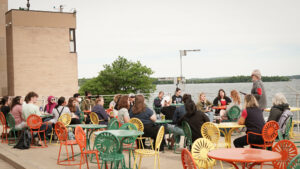
Group of people sitting outdoors in colorful chairs

Undergraduate summer research students, mentors and Sea Grant Director Jim Hurley gather for a kick off meeting of the 10 week experience. Photo: Bonnie Willison

The cohort is the inaugural group of a new program to offer student research opportunities to enhance workforce development skills and expose undergraduates to graduate studies across the University of Wisconsin System and under the auspices of Water@UW-Madison, which connects water scholars across the state’s flagship campus.

“I’m thinking about going to graduate school and this internship will prepare me for freshwater research in both the lab and the field,” said Lily Wagner who smiled through a conversation despite being jetlagged following her return just hours earlier from a semester abroad in Copenhagen studying environmental sciences of the Arctic.

She will join the lab of Christy Remucal of the Department of Civil and Environmental Engineering to understand the degradation rate of the aquatic pesticide 3-trifluoromethyl-4-nitrophenol, which is used to control populations of invasive sea lamprey in the Great Lakes watershed.

Faculty mentors also have high hopes for the pilot research program. “This is a fantastic opportunity for our Water@UW-Madison community to come together in a different way; to share research with a new generation of water scientists,” said Grace Wilkinson, Center for Limnology.

Wilkinson reported being undaunted by the lack of a track record on the program and is looking forward to shepherding a student through a project that will look at how nutrient-rich waters in Dane County are transforming, storing or moving organic material and how the cycle is affected by climate change and anthropogenic pressures.

Her student, Victoria Wright, has experience in science communication. Wilkinson said she’ll tap into Wright’s expertise in creating communications products that will be used as part of a community science monitoring program based at two urban ponds in Middleton.

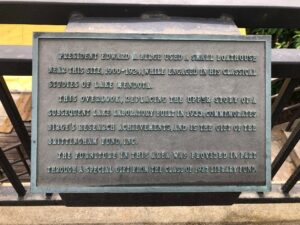
In remarks to the group, Wisconsin Sea Grant and University of Wisconsin Water Resources Institute (WRI) Director Jim Hurley called out features of the Memorial Union’s surroundings that are emblematic of UW-Madison’s leadership in water—nearby buildings, including the Center for Limnology and the Water Science and Engineering Laboratory; Lake Mendota, known as the world’s most-studied lake; and a plaque commemorating former UW-Madison President Edward A. Birge, often cited as the founder of the study of limnology.

Metal plaque with four paragraphs

A plaque on the UW-Madison campus details a history of water research.

Hurley said through the years countless research ideas have been sparked sitting alongside Lake Mendota, over beverages and in the company of enthusiastic scientific peers, and he was confident the 2022 Water@UW-Madison summer research students would be similarly inspired.

Sea Grant and its sister organization WRI are funding the program, as well as the Freshwater Collaborative of Wisconsin. The Freshwater Collaborative is part of a statewide initiative with support from the Wisconsin Legislature and Gov. Evers that is tackling 10 grand water challenges, as well as curriculum development, undergraduate research opportunities, career development and field training experiences for students with an interest in water-related offerings on UW System campuses. The collaborative is also a partnership of universities, connecting with industry, local communities, policymakers and advocacy groups. Its mission is to establish Wisconsin as a world leader in freshwater science, technology, entrepreneurship and economic growth.


The post Summer of research kicks off first appeared on Wisconsin Sea Grant.

Original Article

News Releases | Wisconsin Sea Grant

News Releases | Wisconsin Sea Grant

https://www.seagrant.wisc.edu/news/summer-of-research-kicks-off/?utm_source=rss&utm_medium=rss&utm_campaign=summer-of-research-kicks-off

Moira Harrington

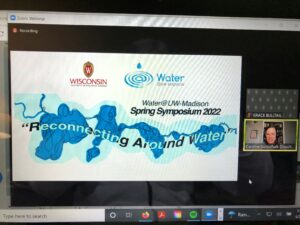
The sixth annual Water@UW-Madison spring symposium took place on Friday, April 22. Providing an opportunity for water scholars and policymakers to reconnect around water, it was an inspirational way to spend Earth Day.

More than 130 people joined the online community and it featured more than 15 speakers who reflected on water connections from the humanities, social sciences and policy worlds. You can catch a recording of the event.

Zoom screen

Caroline Gottschalk-Druschke chairs Water@UW-Madison and led an fascinating panel made up of water scholars.

I’m a member of the Water@UW-Madison executive committee but only played a small role in planning and running of the show. I did act as the morning’s Twitter jockey. The full rundown of live tweets can be found here if you want to keep the positive water vibes alive with a quick read.  

There was a panel that explored fellowships that pair governmental agencies and newly minted water professionals to tackle water challenges. A second panel outlined a Water@UW-Madison program called FLOW that matches artists and researchers.

The scholarship of the third panel, made up of impressive water thinkers, could barely be scratched during the one-hour slot into which they fit. Here are links to their pages, which will allow for further exploration. In all but one case, there is also a tweet related to their comments:

Grace Bulltail, professor in the Nelson Institute @GraceBulltail water, energy and land can be markers of dispossession of Indigenous land and resources

Jen Rose Smith, professor in the American Indian Studies Program and Department of Geography. @sprucehen_

Manny Teodoro, professor in the La Follette School of Public Affairs. 50K water systems offer data-rich einvro says @MPTeodoro. I’ll never run out of things to study

Ingrid Diran, professor in the Department of English, Water is messy; it spills. You have to create barriers to think abt it and also think abt it as a connector

Tricia Gorby-Knoot, UW-Extension Natural Resources Institute director. @Gorby-Knoot Water is a natural entrance point to understanding the impact of the land and can tell us abt healing

Water@UW-Madison is an umbrella entity, organizing and amplifying the water expertise of 130 faculty and staff across more than 40 departments and programs. It represents topics such as water quality, invasive species and water policy. Anyone can join.

The post Keeping the positive water vibes alive-symposium recap first appeared on Wisconsin Sea Grant.

Original Article

Blog | Wisconsin Sea Grant

Blog | Wisconsin Sea Grant

https://www.seagrant.wisc.edu/blog/keeping-the-positive-water-vibes-alive-symposium-recap/?utm_source=rss&utm_medium=rss&utm_campaign=keeping-the-positive-water-vibes-alive-symposium-recap

Moira Harrington

In its fifth year, the Water @ UW-Madison Spring Symposium continues to highlight the most immediate and relevant water-related topics and opportunities for Wisconsin. This year’s free, online symposium is 9 a.m. – noon (CST) Friday, May 7 and is open to all.

“In the true spirit of the Wisconsin Idea, this annual event is about making connections both within the UW-Madison water community and beyond to tackle some of the state’s most difficult water-related challenges,” said Jennifer Hauxwell, associate director of the Aquatic Sciences Center, home of both the University of Wisconsin Water Resources Institute and the Wisconsin Sea Grant College Program and chair of the Water @ UW-Madison executive committee.

This year the agenda includes Gov. Tony Evers (offering pre-recorded remarks), Lt. Gov. Mandela Barnes and Secretary Preston Cole of the Department of Natural Resources Preston to discuss state level water-related issues.

There will be another 23 speakers on four panels: Wisconsin Initiative on Climate Change Impacts Working Groups Update, Spotlight on Arts and Culture, Statewide Coordination on PFAS and Exploring the Intersection Between COVID and Water.  

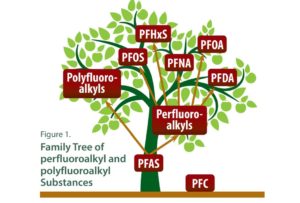
There are a complex and wide array of chemicals in the perfluoroalkyl and polyfluoroalkyl group, each requiring study of their fate, transport and effects. Image: Agency for Substance and Disease Registry, Division of Community Health Investigations, Department of Health and Human Services.

“Offering this event virtually has the benefit of sharing this informative line-up of science-based and timely water conversations to a much wider audience, and all are welcome to attend,” Hauxwell said. “State-level action plans on climate change and PFAS, as well as how state agencies and university researchers are tackling questions at the intersections of water and COVID-19 will be on the agenda. As we confront the major water issues of our time, the symposium shares findings and areas for future investigation and builds connections between the UW water community and those across the state addressing water-related challenges and opportunities.”

Live captioning will be provided for this event. If other accommodations are needed, contact Water@UW-Madison.

Water @ UW-Madison is an umbrella organizing amplifying the water expertise of 130 faculty and staff across more than 40 departments and programs. Its scholarship represents topics such as water quality, invasive species and water policy.

Freshwater research has a long and storied tradition at the UW-Madison. Since the late 1800s, Wisconsin researchers have been pioneers in disciplines like groundwater hydrology, water chemistry and limnology (the study of inland waters) on the shores of Madison’s lakes. More than a 100 years later, the campus continues to boast world-renowned freshwater scientists and serves as a hotbed for new ideas and innovative research in the physical and social sciences. Water @ UW-Madison keeps this tradition alive though the spring symposium, and other activities throughout the year.  

The post Free, Online Symposium on Hot Water Topics: PFAS, Climate Change and COVID/Water first appeared on Wisconsin Sea Grant.

Original Article

News Releases – Wisconsin Sea Grant

News Releases – Wisconsin Sea Grant

https://www.seagrant.wisc.edu/news/free-online-symposium-on-hot-water-topics-pfas-climate-change-and-covid-water/

Moira Harrington

In its fifth year, the Water @ UW-Madison Spring Symposium continues to highlight the most immediate and relevant water-related topics and opportunities for Wisconsin. This year’s free, online symposium is 9 a.m. – noon Friday, May 7 and is open to all.

“In the true spirit of the Wisconsin Idea, this annual event is about making connections both within the UW-Madison water community and beyond to tackle some of the state’s most difficult water-related challenges,” said Jennifer Hauxwell, associate director of the Aquatic Sciences Center, home of both the University of Wisconsin Water Resources Institute and the Wisconsin Sea Grant College Program and chair of the Water @ UW-Madison executive committee.

This year, the agenda includes Gov. Tony Evers (offering pre-recorded remarks), Lt. Gov. Mandela Barnes and Secretary Preston Cole of the Department of Natural Resources Preston to discuss state level water-related issues.

There will be another 23 speakers on four panels: Wisconsin Initiative on Climate Change Impacts Working Groups Update, Spotlight on Arts and Culture, Statewide Coordination on PFAS and Exploring the Intersection Between COVID and Water.

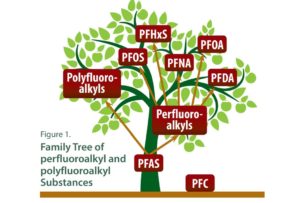
There are a complex and wide array of chemicals in the perfluoroalkyl and polyfluoroalkyl group, each requiring study of their fate, transport and effects. Image: Agency for Substance and Disease Registry, Division of Community Health Investigations, Department of Health and Human Services.

“Offering this event virtually has the benefit of sharing this informative line-up of science-based and timely water conversations to a much wider audience, and all are welcome to attend,” Hauxwell said. “State-level action plans on climate change and PFAS, as well as how state agencies and university researchers are tackling questions at the intersections of water and COVID-19 will be on the agenda. As we confront the major water issues of our time, the symposium shares findings and areas for future investigation and builds connections between the UW water community and those across the state addressing water-related challenges and opportunities.”

Live captioning will be provided for this event. If other accommodations are needed, contact Water@UW-Madison.

Water @ UW-Madison is an umbrella organizing amplifying the water expertise of 130 faculty and staff across more than 40 departments and programs. Its scholarship represents topics such as water quality, invasive species and water policy.

Freshwater research has a long and storied tradition at the UW-Madison. Since the late 1800s, Wisconsin researchers have been pioneers in disciplines like groundwater hydrology, water chemistry and limnology (the study of inland waters) on the shores of Madison’s lakes. More than a 100 years later, the campus continues to boast world-renowned freshwater scientists and serves as a hotbed for new ideas and innovative research in the physical and social sciences. Water @ UW-Madison keeps this tradition alive though the spring symposium, and other activities throughout the year.


The post Free, Online Symposium on Hot Water Topics: PFAS, Climate Change and COVID/Water first appeared on WRI.

Original Article

News Release – WRI

News Release – WRI

https://www.wri.wisc.edu/news/free-online-symposium-on-hot-water-topics-pfas-climate-change-and-covid-water/

Moira Harrington