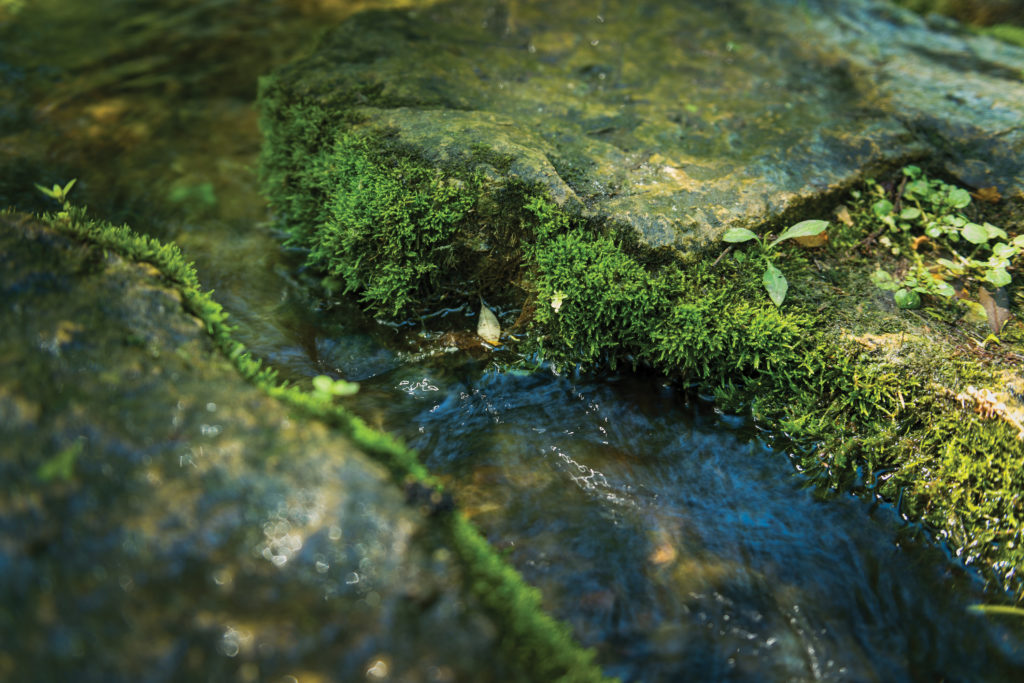
Image by David Nevala

July 1, 2024
By Moira Harrington

Wisconsin has about 1.2 million billion gallons of water underground. If it were above ground, it would submerge the state in 100 feet of water. Simply because there is a lot of groundwater, however, does not mean that volume keeps it immune for challenges related to quantity and quality.

After a rigorous review, the University of Wisconsin Water Resources Institute selected two projects out of 15 that were submitted in a competition held last year. Those new projects got underway on July 1.

“We are so grateful to all of the researchers who submitted proposals to address Wisconsin groundwater challenges. Understanding problems is the first step in finding solutions, and we wish that we could have funded all of the submissions,” said Jennifer Hauxwell, WRI’s director of research. “The projects that we selected for funding this year will go a long way in understanding how surface waters and groundwater are connected as well as how geology interacts with groundwater and contaminants.”

Hauxwell shared these details:

  • Steve Loheide is the lead researcher on a project that will quantify the impact of changing Great Lakes water levels on groundwater storage and flow patterns, lake-groundwater interactions, evapotranspiration and forest productivity to better understand how certain areas can vary in their sensitivity to Lake Michigan’s dynamic water levels. The work will focus in Door County, where ridge and swale topographical features create an ecosystem supporting a diverse plant community. Loheide is in the Department of Civil and Environmental Engineering at UW-Madison. His co-investigators are geology professor Evan Larson from UW-Platteville and UW-Madison graduate Dominick Ciruzzi, now in the geology department at William and Mary.
  • In the second project, Matt Ginder-Vogel will explore the potential for release and transport of iron and manganese from rock within an aquifer underlying Cottage Grove, a village in Dane County. The site has been contaminated by a hydrocarbon spill. The spill could have triggered a release of the naturally occurring chemicals that compromise groundwater quality. Ginder-Vogel, a UW-Madison professor in environmental biogeochemistry water at UW-Madison.
The post 1.2 million billion gallons of groundwater will meet WRI science through new projects first appeared on WRI.
Original Article

News Release | WRI

News Release | WRI

https://www.wri.wisc.edu/news/1-2-million-billion-gallons-of-groundwater-will-meet-wri-science-through-new-projects/

Marie Zhuikov

Image by David Nevala

In show of sibling pride on the occasion of the 60th anniversary year of the University of Wisconsin Water Resources Institute, here’s some background about this sister program that is housed along with our Sea Grant Program in the Aquatic Sciences Center at UW-Madison.

On July 17, 1964, President Lyndon B. Johnson signed the Water Resources Research Act to establish a water resources research institute in each state and Puerto Rico. The program was later expanded to include the District of Columbia, Guam and the U.S. Virgin Islands.

“The Congress has found that we have entered a period in which acute water shortages are hampering our industries, our agriculture, our recreation and our individual health and happiness,” Johnson said.

The 54 institutes are charged with undertaking multidisciplinary water research. They are a federal-state partnership, with federal funds coming through the U.S. Geological Survey and providing dollars to support two tracks, a core grant to each individual program and then a pot of money to annually use for national research competitions to address timely challenges. In Wisconsin, state funding through the Groundwater Coordinating Council also supports WRI.

Johnson’s statement continued, “The new centers will be concerned with municipal and regional, as well as national water problems. Their ready accessibility to state and local officials will permit each problem to be attacked on an individual basis, the only way in which complex characteristics of each water deficiency can be resolved.” Johnson also noted that centers, such as Wisconsin’s, “will enlist the intellectual power of universities and research institutes in a nationwide effort to conserve and utilize our water resources for the common benefit.”

Decades later, WRI continues to embody those 1964 presidential words. It has funded more than 140 research projects, including marquee issues as naturally occurring radium in southeastern Wisconsin. WRI research on those aquifers informed the first-ever binational approval of Great Lakes water withdrawals by a community outside of the basin. Waukesha secured that permission in 2016 because its own supplies were dwindling and contaminated.

Other WRI work has explored the long-term balance between water users in the Central Sands Region of Wisconsin. The scarcity of water in the area creates a tug between those wishing to use it for agriculture and those seeing reduced surface water levels, meaning sporting and recreational opportunities could be compromised.

More contemporary research priorities have been examining PFAS in the state’s waters, the effect of climate change on resources and assessing the extent and impact of pathogens in drinking water.

WRI also recruits and trains the next generation of water leaders. Throughout its history, more than 1,250 students have been trained by working on research projects.

“We are incredibly proud of the students and the work supported by WRI these past 60 years. At the same time, we know that water issues remain critical throughout the state. We look forward to supporting innovative and impactful research in Wisconsin,” WRI Interim Director Christy Remucal said.

The post Happy anniversary, sister first appeared on Wisconsin Sea Grant.

Original Article

Blog | Wisconsin Sea Grant

Blog | Wisconsin Sea Grant

https://www.seagrant.wisc.edu/blog/happy-anniversary-sister/

Moira Harrington

Based on the success of a pilot program on the University of Wisconsin-Madison campus last summer, 31 undergraduate Freshwater@UW Summer Research Scholars opportunities are now open for application.

“The experience over summer definitely cemented my interest in research,” said Manasi Simhan, who was in the 2022 nine-person cohort and participated in a Wisconsin River sediment analysis led by Eric Roden of the UW-Madison Department of Geoscience. “If I had a chance to do it again, I would definitely do it again.”

Like Simhan, summer 2023 undergraduates will be matched with water-related faculty mentors and graduate students to align interests and grow skills applicable to post-graduate studies and future careers. There will be professional development and cross-campus programing, concluding with the chance for students to present results of their individual projects in a group setting.

In-state undergraduate applicants are encouraged to select opportunities that are not on their home campus in an effort to increase collaboration among the eight University of Wisconsin System campuses participating in 2023. Those campuses are Eau Claire, Green Bay, La Crosse, Madison, Manitowoc-Green Bay, Milwaukee, Oshkosh and Superior. Find details and apply at this link: https://water.wisc.edu/wateruw-madison-undergraduate-research-experience The deadline is Feb. 15, 2023.

An additional goal of the program is to create a diverse academic environment by increasing the number of traditionally underserved students in Wisconsin graduate programs, and ultimately, a well-prepared freshwater workforce.

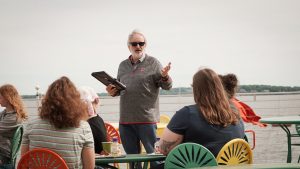
Standing man wearing sunglasses talking with seating listeners and a lake in the background.

Sea Grant Director Jim Hurley enthusiastically describes the summer of research and collaborative learning to come at the kick-off of the summer 2022 scholars’ experience. Photo: Bonnie Willison.

Wisconsin Sea Grant Director Jim Hurley said, ““We’ve had great success with the pilot program last year and we’re anxious to greatly expand opportunities statewide so students can work alongside more of the UW System’s outstanding water researchers.”

The program will run from May 31 through Aug. 5, 2023. In terms of remuneration, there is a $6,000 stipend, $600 meal allowance and provision of housing.

The 2023 freshwater science experiences are funded by Sea Grant and its sister organization, the University of Wisconsin Water Resources Institute, along with resources from the Freshwater Collaborative of Wisconsin.

The Freshwater Collaborative of Wisconsin is a partnership of Wisconsin’s 13 public universities, connecting with industry partners, local communities, policymakers and advocacy groups. Its mission is to establish Wisconsin as a world leader in freshwater science, technology, entrepreneurship and economic growth. The Freshwater Collaborative of Wisconsin is training the next generation of scientists to solve global water resource problems through academic program, collaborative research and career development across the UW System.

The post Freshwater@UW Summer Research Scholars Program opportunities now open first appeared on Wisconsin Sea Grant.

Original Article

News Releases | Wisconsin Sea Grant

News Releases | Wisconsin Sea Grant

https://www.seagrant.wisc.edu/news/freshwateruw-summer-research-scholars-program-opportunities-now-open/?utm_source=rss&utm_medium=rss&utm_campaign=freshwateruw-summer-research-scholars-program-opportunities-now-open

Moira Harrington