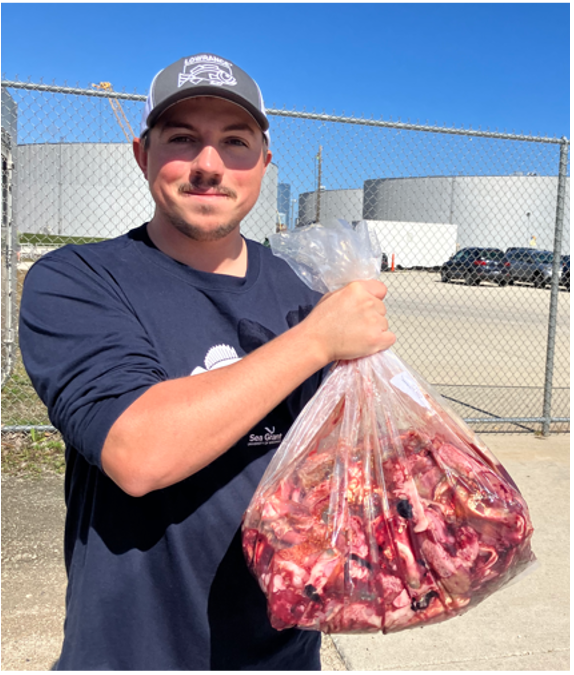
A man in a blue shirt and white hat holds up a big bag of red fish guts

UW–Milwaukee graduate student Kyle Freimuth holding a bag of fish byproducts. Photo: Sharon Moen

When Wisconsin Sea Grant’s Eat Wisconsin Fish team posted the question, “What would you do with a pile of fish guts?,” social media users from across the state creatively responded with ideas that included:

  • Make fly traps
  • Donate them to the raptor center in Spooner
  • Feed them to mink at a mink farm
  • And  – less helpfully – place them under my brother’s car seat on a sweltering July day

“Fertilizer” was the most popular answer to this post, which was one of several that boosted the 100% Wisconsin Fish Contest. The contest ran from September 16-October 24, 2025. It was part of a broader effort to highlight Wisconsin’s sustainable fisheries and the 100% Great Lakes Fish Initiative, which promotes full use of commercially harvested fish – including byproducts.

Grace Elonen of Omro, Wisconsin, submitted the winning entry. She wrote:

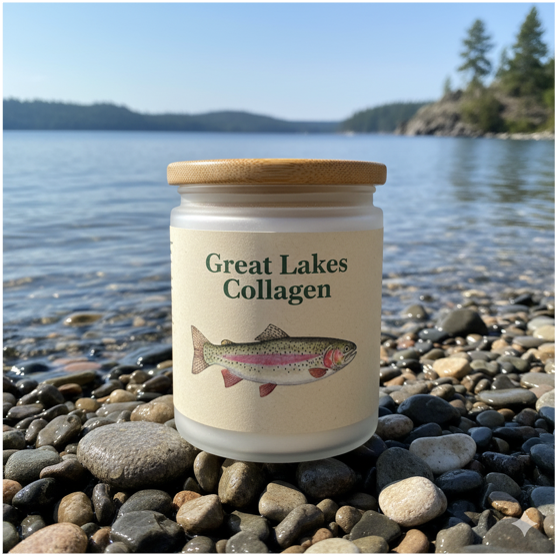
“Fish scales are often the first part discarded when harvesting. Fish scales and skin are comprised of collagen… Knowing the collagen source was sustainably harvested is a good selling point. Knowing the collagen came from our own Great Lakes would be even better. Tagline: Take a little bit of the Great Lakes with you everywhere.”

John Schmidt, program manager for the Conference of the Great Lakes St. Lawrence Seaway Governors and Premiers (GSGP) 100% Great Lakes Fish Initiative, praised the idea. “Collagen from Great Lakes fish scales and skins squarely advances 100% fish goals, has multiple markets, and we’ve already flagged collagen as one of the best-case strategies for the region,” he said.

An AI-generated image of a glass jar of fish collagen sitting on a rocky beach

The winning idea for using more parts of a fish involved scales and skin. Photo credit: Gemini AI-generated image submitted by Grace Elonen.

Judges – including Schmidt, two commercial fishers, and a University of Wisconsin-Madison undergraduate – commended Elonen’s regional branding concept, noting that taglines like the one Elonen offered underscore both local pride and market potential.

Charlie Henriksen, co-owner of Henriksen Fisheries and a contest judge, applauded the thoughtfulness behind many submissions. “All the ideas had some value, and I appreciate the people who provided serious replies,” he said.

He gave special mention to making dog treats from dehydrated fish skins and using fish parts for stock. When it comes to fish stock, he said, “The issue to overcome is producing a stock with consistent flavor and texture. Many chowders now use clam juice, so a genuine whitefish stock would be valuable.”

Led by GSGP, the 100% Great Lakes Fish Initiative brings together dozens of partners – including Wisconsin Sea Grant and Wisconsin commercial fishers, fish farmers, and processors – to demonstrate how every part of Great Lakes fish can be used for food, products, and other innovative purposes. Wisconsin Sea Grant’s online contest may serve as a model for similar efforts in other Great Lakes states according to Schmidt.

The contest was made possible through support from GSGP, along with interns Kyle Freimuth and Wyatt Slack, and Wisconsin Sea Grant’s communications team. Special thanks to judges Charlie Henriksen (Henriksen Fisheries), Jessica Resac (Halvorson Fisheries), John Schmidt (GSGP), and UW–Madison undergraduate Wyatt Slack.

The post Guts and glory: Thinking beyond the fillet first appeared on Wisconsin Sea Grant.
Original Article

News Releases | Wisconsin Sea Grant

News Releases | Wisconsin Sea Grant

https://www.seagrant.wisc.edu/news/guts-and-glory-thinking-beyond-the-fillet/
Andrew Savagian

A Wisconsin Sea Grant event held in Madison this fall celebrated Wisconsin’s water, from drinking water to water on which businesses rely for their livelihoods. These include commercial fishing and aquaculture operations.

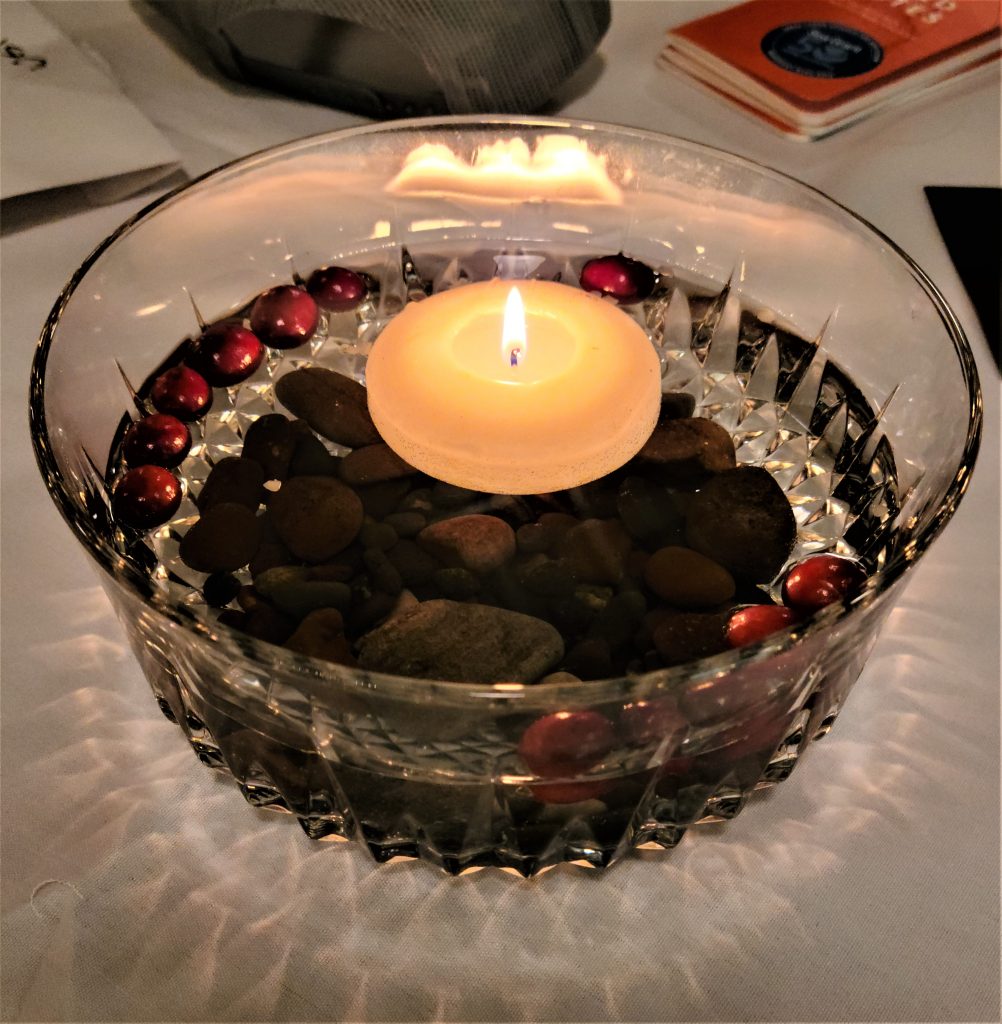
A centerpiece at the Taste of Wisconsin Waters event featured a floating candle, cranberries and rocks. Image credit: Marie Zhuikov, Wisconsin Sea Grant

This first-ever, invitation-only event was organized by Sharon Moen, food fish outreach specialist. She got the idea from conducting a needs assessment with commercial fishermen and fish farmers in Wisconsin.

“They told me what they would really like Sea Grant to help them with was articulating the importance of their industries to decision-makers,” Moen said. She incorporated that into the event by inviting state legislators and natural resource professionals. Two other objectives were to celebrate Wisconsin Sea Grant’s 50th anniversary and the United Nations’ Year of Artisanal Fisheries and Aquaculture.

“The U.N. really took a bold stand on supporting local fishing communities and what they bring to society,” Moen said. “Certainly, aquaculture and fisheries in Wisconsin could be considered artisanal compared to some of the big operations.”

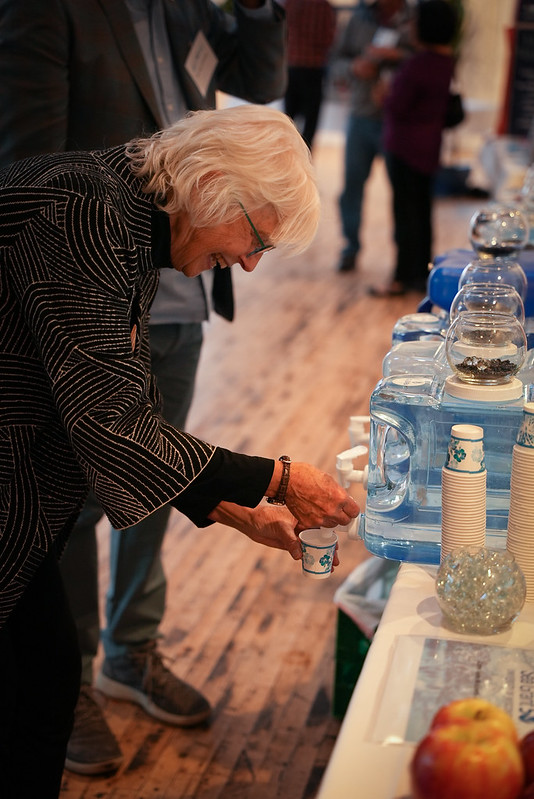
A Taste of Wisconsin Waters featured a water bar where event-goers could sample nine waters from around the state and vote for their favorite. Same for a fish spread table, which featured eight spreads donated by commercial fisherman and fish farmers throughout the state.

The favorite Wisconsin water was Rock Springs Free Spring water from a natural spring near Madison. The favorite fish spread was a tie between Bodin Fisheries and Hoop’s Fish Market. Both are located in Bayfield, Wisconsin, and used whitefish as their base ingredient.

An event participant samples Wisconsin water from the water bar. Credit: Bonnie Willison, Wisconsin Sea Grant

“People had a good chance to network with each other and taste some appetizers made out of the fish and listen to some speeches,” said Moen. “I was really pleased that Preston Cole was able to join us. He’s the secretary of the Department of Natural Resources in Wisconsin, and then Marlon White Eagle, the president of the Ho-Chunk Nation was able to join us, too. So, it was really great to have dignitaries and scientists and fish producers all mingling together and to hear those conversations.”

Speeches were also offered by Wisconsin Sea Grant Director Jim Hurley; Steve Summerfelt, chief science officer for Superior Fresh, an aquaponics business that raises Atlantic salmon and grows leafy greens in Hixton, Wisconsin; and Charlie Henriksen of Henriksen Fisheries.

Cole outlined current challenges facing water systems in Wisconsin. “There’s a lot of places in the state of Wisconsin that people don’t have surety when they turn on their tap that they’re going to have clean fresh drinking water,” he said. “A lot of the circumstances are lead laterals in some of our older cities. I think there’s probably about 100 communities still in Wisconsin spread all across the state that still have lead laterals. And for children, there is no safe level for lead. We know that emerging contaminants like PFAS [per- and polyfluoroalkyl substances] in our drinking water do serious harm where we’ve been finding legacy contaminants from firefighting foam.”

Cole also shared some thoughts on a “Taste of Wisconsin Waters.”

“I think this is awesome. For folks in this room tonight, from commercial fishermen, to researchers, to restauranteurs, people who count on that fishing industry, people who count on the research that’s occurring – I met a couple of those researchers this evening – and I think it’s a wonderful way to look forward by relishing how far we’ve come in the past and providing clean water and research around our water systems.”

Summerfelt with Superior Fresh was also impressed by the event. “I’m ecstatic that Sea Grant put this together to recognize how Wisconsin uses water for food and brought in aquaculture. Sea Grant has not only helped educate consumers about eating Wisconsin seafood, which is so good for them because there’s nowhere else you can get omega-3s, which are good for your brain and heart, like you can get it from seafood. And then, Wisconsin Sea Grant has also been instrumental in funding research that’s helped the technology develop that’s used in Superior Fresh.”

Depending on funding, similar events may happen in the future, and they may be open to the public.

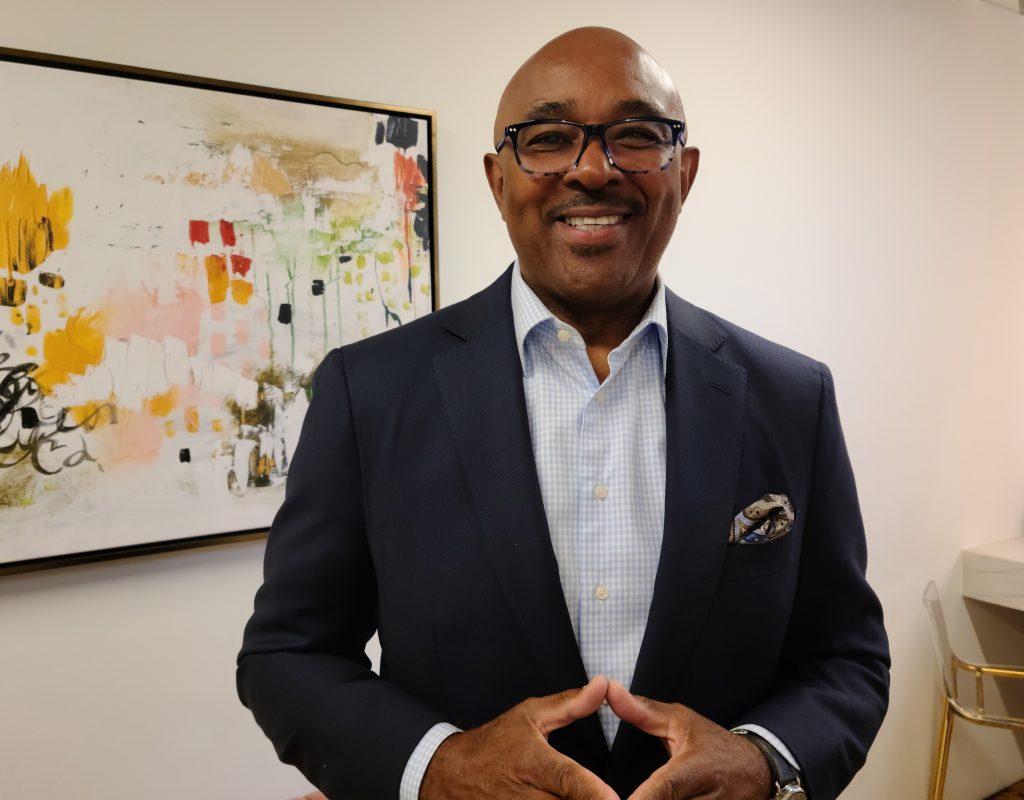
Preston Cole. Credit: Marie Zhuikov, Wisconsin Sea Grant

Many of the outcomes will take a while to manifest, but Moen explained that one connection was made right away. “A thousand arctic char from the Northern Aquaculture Demonstration Facility that is operated through the University of Wisconsin-Steven’s Point, got homes. One of the fish producers, because he heard about them being available, came and collected them and took them back to his farm for growing out as an experiment. So that was a big plus,” Moen said.

She also said that networking among the event-goers led to site visits to research and education facilities and that she’s received invitations to host similar events in two other Wisconsin communities. Moen and Emma Hauser, Wisconsin Sea Grant’s aquaculture and education outreach specialist, recently met with staff from the Wisconsin Department of Agriculture, Trade and Consumer Protection to discuss working together to support the food-fish industry. “This happened as a direct result of the Taste of Wisconsin Waters,” Moen said.

The post A Taste of Wisconsin Waters first appeared on Wisconsin Sea Grant.

Original Article

News Releases | Wisconsin Sea Grant

News Releases | Wisconsin Sea Grant

https://www.seagrant.wisc.edu/news/a-taste-of-wisconsin-waters/?utm_source=rss&utm_medium=rss&utm_campaign=a-taste-of-wisconsin-waters

Marie Zhuikov