By Danielle Kaeding, Wisconsin Public Radio

This article was republished here with permission from Wisconsin Public Radio.


The National Park Service recently acquired more than 200 acres along the south shore of Lake Superior in northern Wisconsin for the country’s longest national scenic trail.

The North Country National Scenic Trail is part of the National Park Service and stretches 4,800 miles across eight states from North Dakota to Vermont. About 1,500 miles of the trail has yet to be built.

The agency acquired 213 acres in Iron County this spring from the national nonprofit Trust for Public Land, said Chris Loudenslager, the trail’s superintendent. Iron County land records show the nonprofit group paid roughly $2.5 million to buy the property from a private landowner in September.

“When this property became available, that presented the opportunity to get the trail off the road and into a beautiful property that really provides for the type of experience the North Country National Scenic Trail is intended to provide,” Loudenslager said.

The National Park Service purchased the property with money from the Land and Water Conservation Fund. The National Park Foundation and Wyss Foundation also offset costs of the acquisition for the Trust for Public Land.

Loudenslager said the purchase means officials will be able to move about 3 miles of the trail off road.

Efforts to protect the property go back almost 20 years, said Will Cooksey, senior project manager at the Trust for Public land. The land purchased will connect Saxon Harbor County Park to the Montreal River that separates Wisconsin from Michigan’s Upper Peninsula.

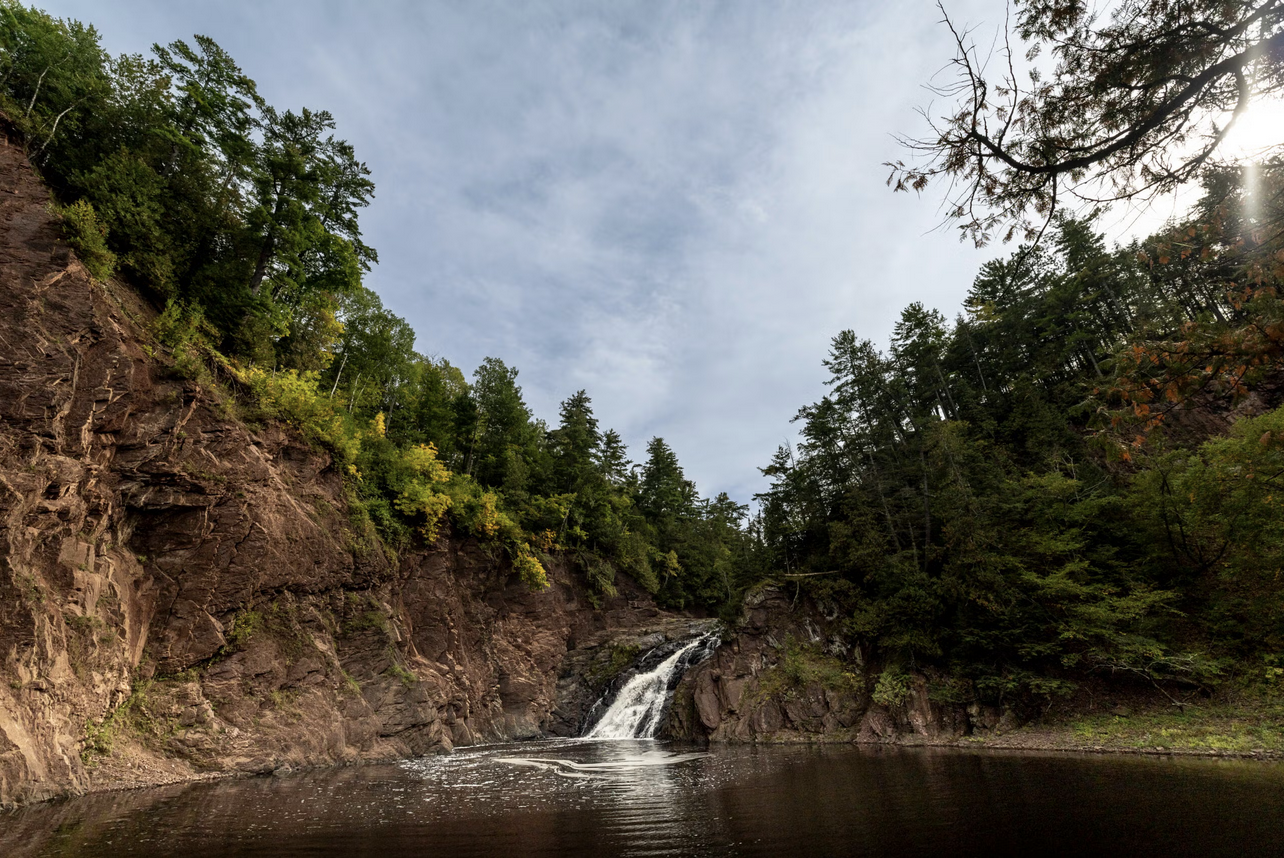
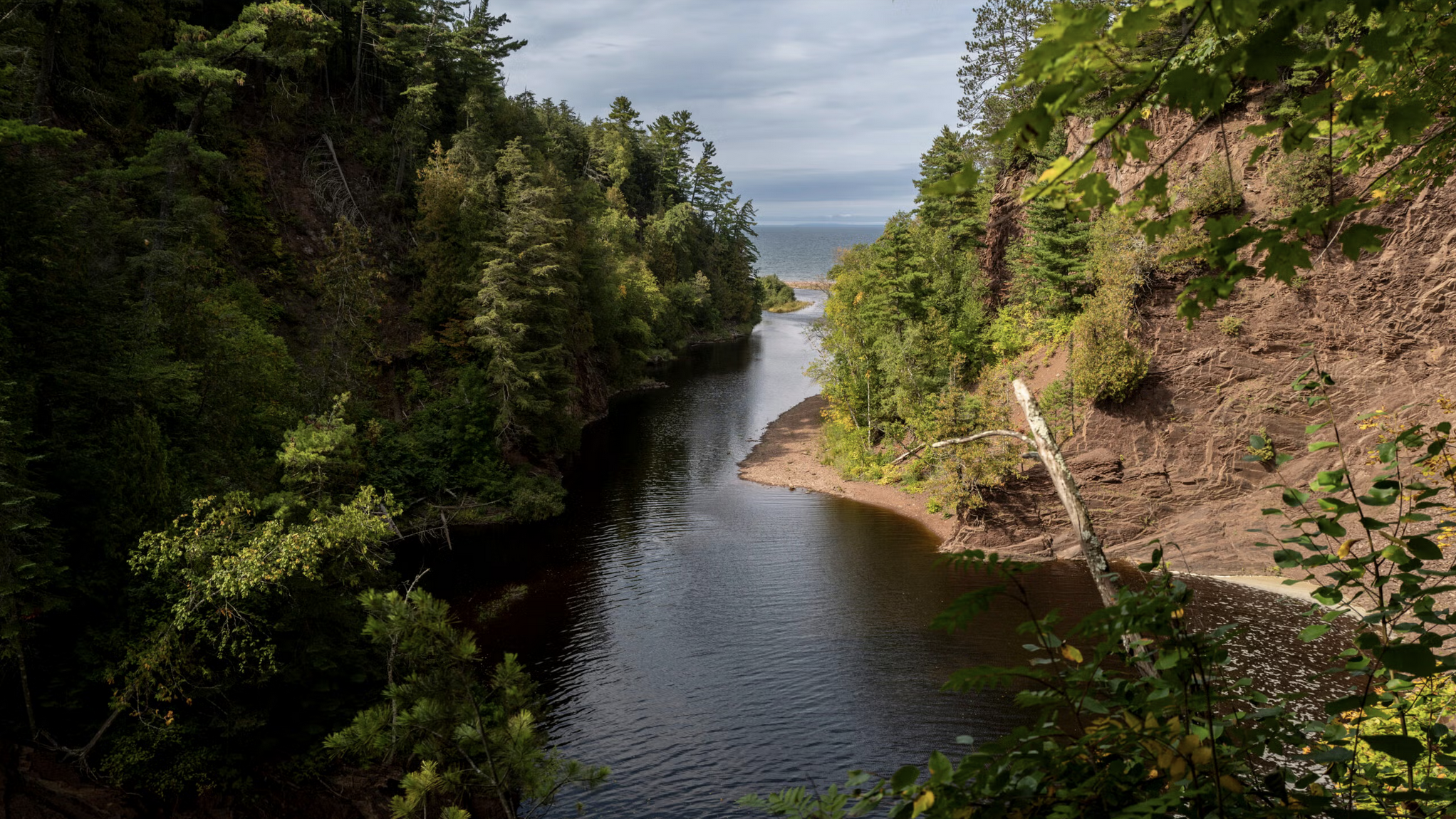
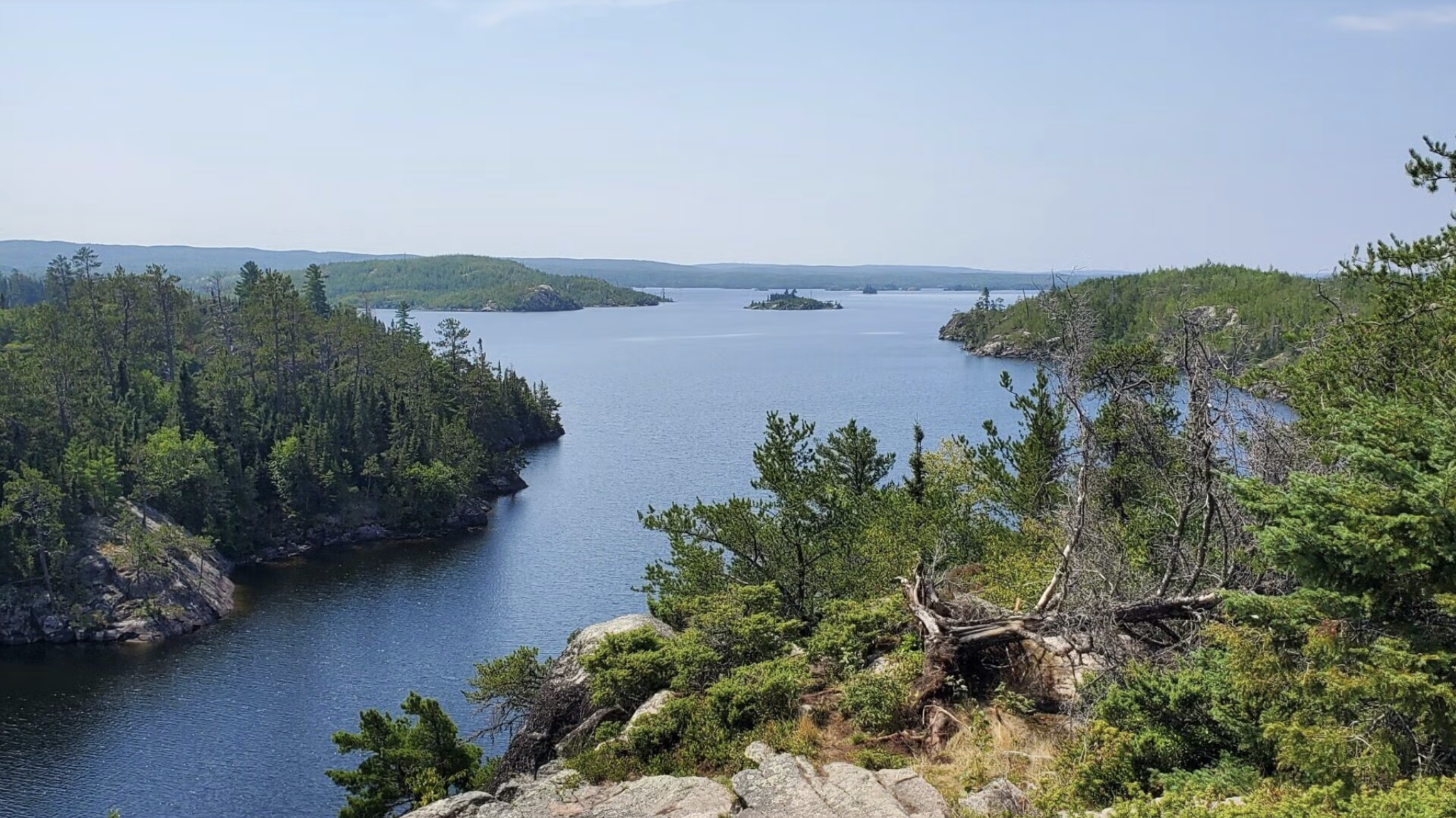
“The property is outstandingly beautiful. It includes 1,300 feet of shoreline along Lake Superior, so it has commanding views of Lake Superior. Additionally, it has roughly 2,100 feet of shoreline along the Montreal River, including the mouth of the river with the lake,” Cooksey said. “This is a portion of the river that includes Superior Falls as it cascades down about 90 feet into a beautiful pool.”

A view of Superior Falls, which drops 90 feet before the Montreal River empties into Lake Superior. Sara Rubinstein/Courtesy of the Trust for Public Land via Wisconsin Public Radio

Eric Peterson, forest administrator for Iron County, said the county had previously examined buying the property in 2017. He said thousands of people typically visit Iron County on Memorial Day weekend with many of them going through Saxon Harbor campground. He anticipates the acquisition may increase traffic in the future.

“With the North Country trail going through that property now and accessing Superior Falls and the Montreal River, that’s just another access point for people to go and see those things when they’re at our facility,” Peterson said.

Loudenslager said a historic trade route for Native Americans known as the Flambeau Trail followed the Montreal River through the area. It was also the site of a fur trading post operated by John Jacob Astor’s American Fur Company from 1808 to 1830, according to the Trust for Public Land.

In a statement, Gov. Tony Evers said the acquisition builds on work to conserve lands in Wisconsin “while bolstering our highly successful outdoor recreation economy and ensuring these spaces are accessible for generations of Wisconsinites and visitors to come.”

Outdoor enthusiasts provided a record-breaking $12 billion boost to Wisconsin’s economy in 2024, according to most recent federal data released this year. Overall, the state’s outdoor recreation industry supports more than 100,000 jobs.

Loudenslager said the National Park Service will work with partners, including the North Country Trail Association, on scouting a potential route through the property while ensuring protection of cultural and natural resources. Construction of the trail could begin as early as next year.

“I think it’s a fantastic achievement for the North Country National Scenic Trail,” Loudenslager said. “It moves the needle toward completing the trail where we have the opportunity to get temporary road walks replaced by actual trail that not only benefits the hikers, but also benefits the local communities.”

About 210 miles of the trail run through Wisconsin, of which about 145 miles are ready to hike.


The post Around 200 acres protected along Lake Superior for longest national scenic trail appeared first on Great Lakes Now.
Original Article

Great Lakes Now

Great Lakes Now

https://www.greatlakesnow.org/2026/05/26/around-200-acres-protected-along-lake-superior-for-longest-national-scenic-trail/
Wisconsin Public Radio

By Danielle Kaeding, Wisconsin Public Radio

This article was republished here with permission from Wisconsin Public Radio.


Canadian energy firm Enbridge can keep building a new stretch of its Line 5 oil and gas pipeline in northern Wisconsin except in waterways where the company needs additional permits, a Bayfield County judge ruled Friday.

The decision is largely a win for Enbridge and its embattled project to reroute Line 5 around the Bad River Tribe’s Reservation in northern Wisconsin. The judge, however, granted a partial victory to the tribe and environmental groups who sued for review of a decision upholding state approvals for the reroute. In February, an administrative law judge upheld permits issued by the Wisconsin Department of Natural Resources for the project.

In Friday’s order, Bayfield County Circuit Court Judge John Anderson said the tribe and groups failed to persuade him that he should pause approvals for the project altogether.

“Enbridge’s permits previously granted are stayed only in relation to work areas along Line 5 for which Enbridge is required to obtain additional permits,” Anderson wrote.

The tribe and environmental groups argued Enbridge was ineligible to obtain permits to install structures in certain rivers and streams because the company didn’t own the land next to those waterways. The judge agreed the practice under which the company is now obtaining permits at four waterway crossings “may be on tenuous legal footing.”

Both sides see wins


In a statement, Bad River Tribal Chairwoman Elizabeth Arbuckle said she is happy with the judge’s decision to halt some work on Enbridge’s reroute of Line 5.

“We are bound by a need and desire for clean water to drink, a clean environment for animals and plants to thrive in, and a commitment to the highest quality of life for our people,” Arbuckle wrote. “We hope the Court will keep the stay in place and hear us out fully in the weeks to come.”

Enbridge spokesperson Juli Kellner called the ruling an important decision that allows the company’s work to continue, saying Line 5 delivers fuel that’s critical for Midwest refineries.

“State permits for the project were approved after an exhaustive four-year review by the Wisconsin Department of Natural Resources and then upheld after a year-long independent review by an administrative law judge. Federal permits have also been received from the U.S. Army Corps of Engineers,” Kellner wrote.

Under the ruling, Enbridge can’t move ahead with construction of permanent structures to stabilize banks in four creeks where erosion could threaten water quality or exposure of new pipe that would be installed. The company and landowners applied for permits that have not yet been issued by the DNR.

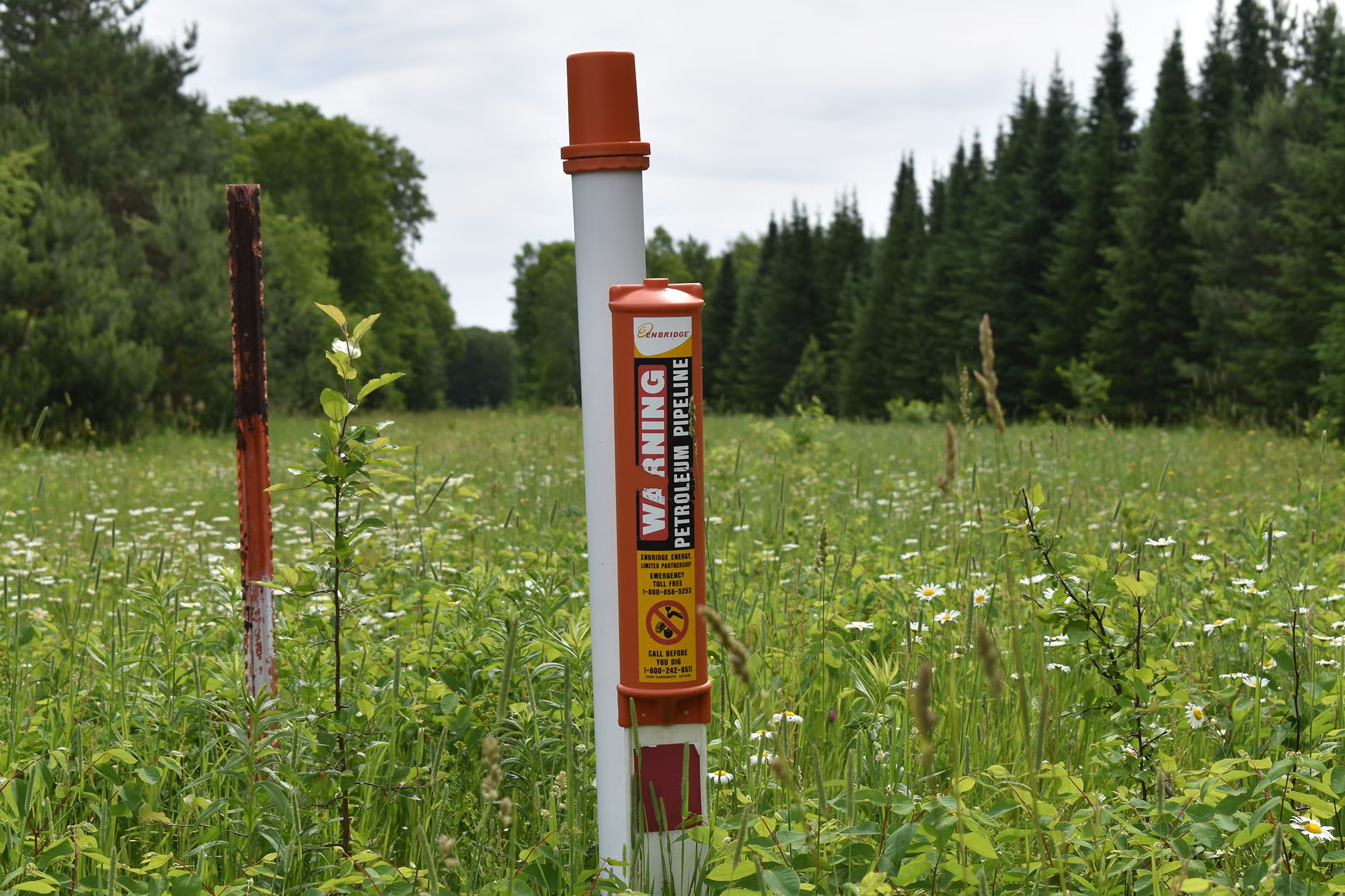
Enbridge’s Line 5 carries up to 23 million gallons of oil daily from Superior across northern Wisconsin and Michigan to Ontario. The company proposed a 41-mile reroute of Line 5 after the Bad River Tribe sued in 2019 to shut down the pipeline on its lands. The project would cross about 200 waterways and affect around 100 acres of wetlands in Ashland and Iron counties.

The $450 million project has undergone years of review, protests, tens of thousands of comments and legal challenges. Proponents say the project would employ 700 union workers and contribute $135 million to Wisconsin’s economy. Opponents point to multiple spills on Enbridge pipelines including the release of almost 70,000 gallons of oil in Jefferson County in 2024.

In 2023, U.S. District Court Judge William Conley ordered Enbridge to shut down or reroute Line 5 around the Bad River reservation by mid-June this year and ordered the company to pay $5.15 million for trespassing on roughly 2 miles of tribal lands. Both the tribe and Enbridge appealed the decision. In March, Conley paused his shutdown order until a federal appeals court issues a ruling, citing potential “devastating” impacts of a sudden shutdown.


The post Judge halts some work on Enbridge’s Line 5 reroute in northern Wisconsin appeared first on Great Lakes Now.

Original Article

Great Lakes Now

Great Lakes Now

https://www.greatlakesnow.org/2026/05/21/judge-halts-some-work-on-enbridges-line-5-reroute-in-northern-wisconsin/

Wisconsin Public Radio

By Beatrice Lawrence, Wisconsin Public Radio

This article was republished here with permission from Wisconsin Public Radio.


Johnson Bridgwater celebrated his 50th birthday by spending a full month in the wilderness, paddling and camping in the hundreds of thousands of acres that make up the Boundary Waters Canoe Area Wilderness in northeastern Minnesota.

It’s a place that reminds him of his father, whom Bridgwater lost when he was in his 20s.

“My father, who was a zoologist, considered it one of the last places in North America that you could truly get to some place pristine that had not been impacted by settlers or industry,” Bridgwater said.

He’s not alone. Among the more than 150,000 visitors the region sees each year, a significant portion of them come from Wisconsin. 

On Tuesday, President Donald Trump signed a bill overturning a 20-year mining ban in the area surrounding the Boundary Waters. The decision paves the way for the Chilean company Twin Metals to build a copper and nickel mine in the area, which is the world’s largest known undeveloped copper, nickel, cobalt and platinum group metals deposit. Supporters of the idea hope for a boom in jobs, but critics worry about pollution and contamination, and an economic impact on tourism and recreation.

Wisconsin lawmakers in both chambers of Congress voted on the bill along party lines — Republicans voted to overturn the ban, Democrats to sustain it.

Bridgwater, who is the water advocates organizer for River Alliance of Wisconsin, said that the decision doesn’t only affect Minnesota.

“All water is connected, and I’m not sure that the general population truly understands how big that connection is,” Bridgwater told WPR’s “Wisconsin Today.” “Up north — northern Minnesota, northern Wisconsin, the Upper Peninsula of Michigan — they carry (one) water identity. It also has very busy state lines. People are traveling across all three of those states daily.”

Economic boom or environmental disaster?

After Congress designated the Boundary Waters as a wilderness area in 1964, a robust outdoor industry sprung up in northeastern Minnesota as people flocked there every year to paddle, camp, fish and enjoy nature in the uniquely pristine and remote setting.

Critics of the Twin Metals mining project say that the recreation economy of the area will be put at risk if companies are allowed to mine nearby.

“This area is beloved,” said Minnesota Public Radio reporter Dan Kraker, who has been covering mining projects near the Boundary Waters for 15 years. “People are extraordinarily concerned about the potential pollution impacts on this amazing landscape. … They argue, even without the pollution concerns, that these mines surrounding the wilderness area could be a detractor to investment and recreational development.”

But advocates for the projects say that these mines will instead boost the area’s economy by creating thousands of jobs in both mining and construction, and will provide the U.S. with vital resources. 

“This progress ensures our state remains competitive when it comes to workforce and jobs, not to mention the global impact of reducing foreign dependence for these critical minerals,” Dave Lislegard, Jobs for Minnesotans executive, said in a statement

A 2020 Harvard study compared the projected economic impact of a 20-year mining ban in the area with a scenario in which the Twin Metals mine is developed. That study found that introducing copper-nickel mining would likely have a negative overall effect on the regional economy.

Northern Minnesota has a rich mining history. But copper and nickel mining carry different environmental risks than the traditional iron ore mining in the area.

“When sulfide-bearing ore is brought up from under the ground, and it reacts with air and water, it can create sulfuric acid and result in what’s known as acid mine drainage, and this can leach heavy metals out of the ground and potentially into the water,” Kraker said.

In 2023, the Biden administration enacted a 20-year ban on mining in the 225,000 acres surrounding the Boundary Waters. Twin Metals claimed this “locked up” necessary resources and negatively impacted communities in the area. The new law repeals that ban.

Twin Metals said that the protections already in place are sufficient enough to prevent significant environmental impact.

“Projects must prove they can meet the stringent environmental standards that have long been in place in Minnesota before moving forward,” said Kathy Graul, director of public affairs and communications for Twin Metals. 

But Bridgwater pointed to a report assembled by mining researcher Steven Emerman for the Friends of the Boundary Waters Wilderness, which found that even “model” sulfide ore mines have extensive records of environmental contamination.

Bridgwater is concerned not only about recreation in the Boundary Waters, but also the wild rice economy that exists in the region and how it intersects with the hunting and gathering rights of tribes in the Midwest.

“What you’re looking at is this overlay of uses that have been functioning and doing what they were intended to do for hundreds of years,” Bridgwater said. “We would like to see anything that can be done to stop metallic sulfide mining that could potentially impact these water environments.”

Even with the mining ban being repealed, it’s not clear if or when the mine will be approved, Kraker said.

“The state will have ultimate say on whether this goes forward, in addition to federal regulators also having to sign off on any potential mines in this area,” Kraker said. “So there is a long story yet to be written.”


The post Why mining in Minnesota’s Boundary Waters matters to Wisconsin appeared first on Great Lakes Now.

Original Article

Great Lakes Now

Great Lakes Now

https://www.greatlakesnow.org/2026/05/08/why-mining-in-minnesotas-boundary-waters-matters-to-wisconsin/

Wisconsin Public Radio